question a polar function is given by r = f(θ) = sin(3/2θ) - 2. as θ increases on the interval -4π/3 < θ <…
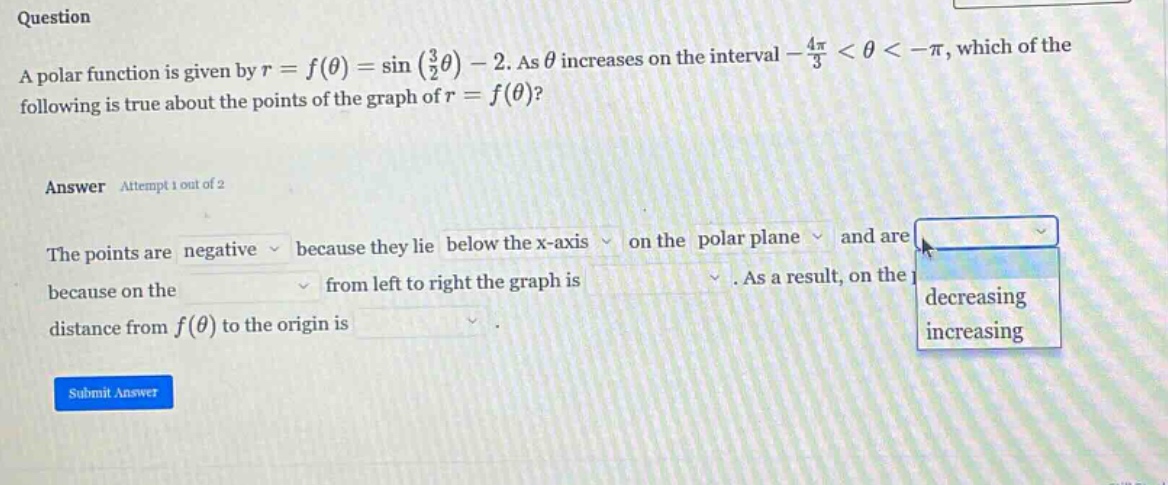
question a polar function is given by r = f(θ) = sin(3/2θ) - 2. as θ increases on the interval -4π/3 < θ < -π, which of the following is true about the points of the graph of r = f(θ)? answer attempt 1 out of 2 the points are negative because they lie below the x - axis on the polar plane and are because on the from left to right the graph is. as a result, on the distance from f(θ) to the origin is. submit answer
Answer
Explanation:
Step1: Analyze the range of $\theta$
Given $-\frac{4\pi}{3}<\theta<-\pi$. When we consider the polar - coordinate relationship $x = r\cos\theta$ and $y = r\sin\theta$, and $r=\sin(\frac{3}{2}\theta)-2$.
Step2: Determine the sign of $r$
Let's first consider the function $y = \sin(\frac{3}{2}\theta)$. For $\theta\in(-\frac{4\pi}{3},-\pi)$, we know that $\frac{3}{2}\theta\in(- 2\pi,-\frac{3\pi}{2})$. The sine - function $y = \sin t$ where $t=\frac{3}{2}\theta$ has values in the range $(0,1)$ in the interval $t\in(-2\pi,-\frac{3\pi}{2})$. Then $r=\sin(\frac{3}{2}\theta)-2$. Since $\sin(\frac{3}{2}\theta)\in(0,1)$, $r=\sin(\frac{3}{2}\theta)-2<0$. In polar coordinates, a negative $r$ value means the points are in the opposite direction of the terminal side of $\theta$. Geometrically, in the given range of $\theta$, the points lie below the $x$ - axis on the polar plane.
Step3: Analyze the behavior of $r$ as $\theta$ increases
We know that $y = \sin(\frac{3}{2}\theta)$ is increasing on the interval $\theta\in(-\frac{4\pi}{3},-\pi)$ (because for $y = \sin t$ and $t=\frac{3}{2}\theta$, when $t\in(-2\pi,-\frac{3\pi}{2})$, $\sin t$ is increasing). Since $r=\sin(\frac{3}{2}\theta)-2$, as $\theta$ increases in the interval $(-\frac{4\pi}{3},-\pi)$, $r$ is increasing. In polar coordinates, $|r|$ represents the distance from the point $(r,\theta)$ to the origin. Since $r<0$ and $r$ is increasing (becoming less negative), $|r|$ is decreasing.
Answer:
The points are negative because they lie below the x - axis on the polar plane and are increasing because on the interval from left to right the graph is increasing. As a result, on the distance from $f(\theta)$ to the origin is decreasing.