question a polar function is given by r = f(θ) = 3 sin(πθ)+6. as θ increases on the interval 0 < θ < 0.5…
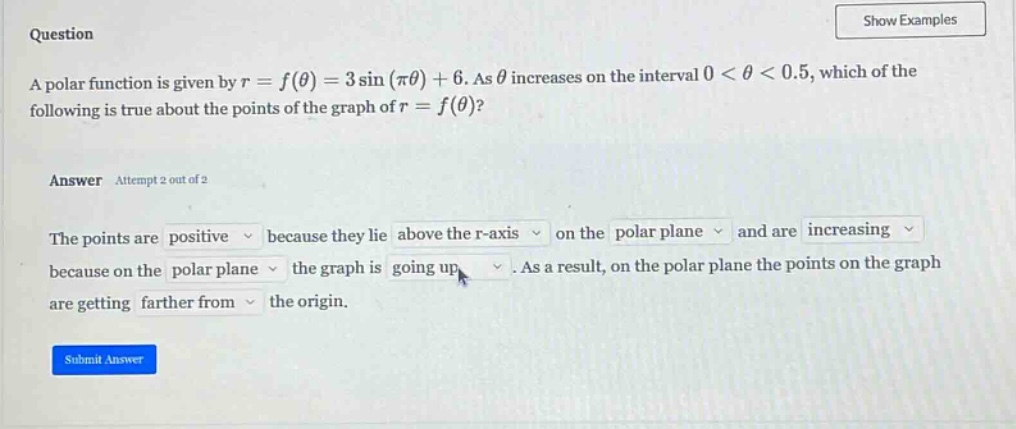
question a polar function is given by r = f(θ) = 3 sin(πθ)+6. as θ increases on the interval 0 < θ < 0.5, which of the following is true about the points of the graph of r = f(θ)? answer attempt 2 out of 2 the points are positive because they lie above the r - axis on the polar plane and are increasing because on the polar plane the graph is going up. as a result, on the polar plane the points on the graph are getting farther from the origin.
Answer
Explanation:
Step1: Analyze the function for the given interval
For (0 < \theta<0.5), consider (y = r\sin\theta=(3\sin(\pi\theta)+ 6)\sin\theta). Since (\sin\theta>0) for (0 < \theta<0.5) and (3\sin(\pi\theta)+6>0) (because (- 1\leqslant\sin(\pi\theta)\leqslant1), so (3\sin(\pi\theta)+6\geqslant3\times(-1)+6 = 3>0)), the points have positive (y - )components in the polar - Cartesian conversion (x = r\cos\theta,y = r\sin\theta), which means they lie above the (r) - axis on the polar plane.
Step2: Analyze the rate of change of (r)
Differentiate (r = f(\theta)=3\sin(\pi\theta)+6) with respect to (\theta). Using the chain - rule, (r'=3\pi\cos(\pi\theta)). For (0 < \theta<0.5), (\cos(\pi\theta)>0), so (r'>0). This means the value of (r) is increasing as (\theta) increases in the interval (0 < \theta<0.5). In the polar plane, (r) represents the distance from the origin. So the points on the graph are getting farther from the origin.
Answer:
The points are positive because they lie above the r - axis on the polar plane and are increasing because on the polar plane the graph is going up. As a result, on the polar plane the points on the graph are getting farther from the origin.