question 2 of 8\nthe population $p$ of a species of fish decreases at a rate proportional to the population…
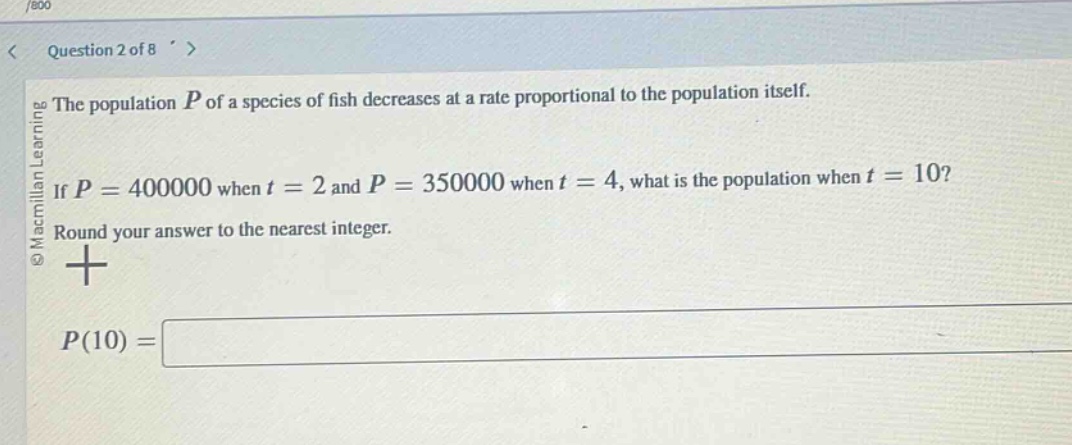
question 2 of 8\nthe population $p$ of a species of fish decreases at a rate proportional to the population itself.\nif $p = 400000$ when $t = 2$ and $p = 350000$ when $t = 4$, what is the population when $t = 10$?\nround your answer to the nearest integer.\n$p(10)=$
Answer
Explanation:
Step1: Set up the differential equation
The rate of change of the population $\frac{dP}{dt}$ is proportional to $P$, so $\frac{dP}{dt}=-kP$ (negative because it's decreasing), where $k$ is the proportionality - constant. The general solution of this differential equation is $P(t)=P_0e^{-kt}$.
Step2: Use the given data points to find $k$ and $P_0$
When $t = 2$, $P(2)=P_0e^{-2k}=400000$. When $t = 4$, $P(4)=P_0e^{-4k}=350000$. Divide the second equation by the first equation: $\frac{P_0e^{-4k}}{P_0e^{-2k}}=\frac{350000}{400000}$. Simplify the left - hand side using the exponent rule $\frac{a^m}{a^n}=a^{m - n}$: $e^{-4k+2k}=e^{-2k}=\frac{350000}{400000}=\frac{7}{8}$. Take the natural logarithm of both sides: $-2k=\ln(\frac{7}{8})$, so $k =-\frac{1}{2}\ln(\frac{7}{8})=\frac{1}{2}\ln(\frac{8}{7})$. Substitute $k$ into $P_0e^{-2k}=400000$. Since $e^{-2k}=\frac{7}{8}$, then $P_0\times\frac{7}{8}=400000$, and $P_0=\frac{400000\times8}{7}$.
Step3: Find the population at $t = 10$
$P(t)=P_0e^{-kt}$, substitute $P_0=\frac{400000\times8}{7}$, $k=\frac{1}{2}\ln(\frac{8}{7})$, and $t = 10$ into the formula. $P(10)=\frac{400000\times8}{7}e^{-10\times\frac{1}{2}\ln(\frac{8}{7})}$. Using the exponent rule $a\ln(b)=\ln(b^a)$ and $e^{\ln(x)} = x$, we have $P(10)=\frac{400000\times8}{7}e^{-5\ln(\frac{8}{7})}=\frac{400000\times8}{7}(\frac{7}{8})^5$. $P(10)=\frac{400000\times8}{7}\times\frac{7^5}{8^5}=\frac{400000\times7^4}{8^4}$. $P(10)=\frac{400000\times2401}{4096}\approx234131$.
Answer:
$234131$