question the position of a hummingbird flying along a straight line is given by the function s(t)=-2t³/3 +…
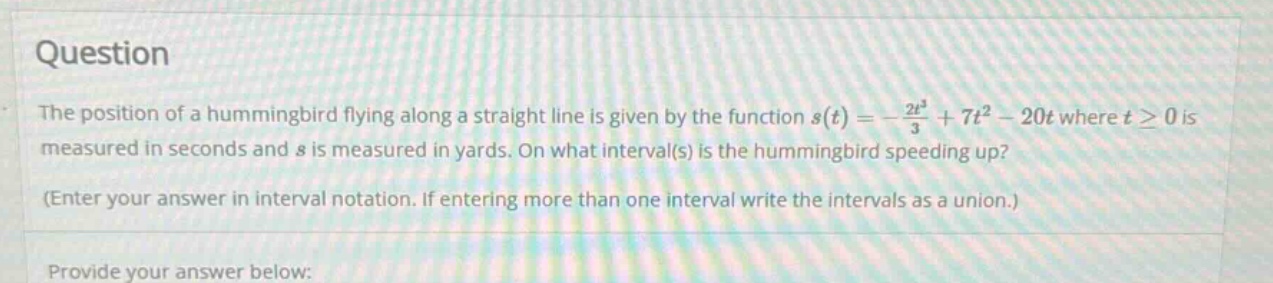
question the position of a hummingbird flying along a straight line is given by the function s(t)=-2t³/3 + 7t² - 20t where t≥0 is measured in seconds and s is measured in yards. on what interval(s) is the hummingbird speeding up? (enter your answer in interval notation. if entering more than one interval write the intervals as a union.) provide your answer below:
Answer
Explanation:
Step1: Find the velocity function
The velocity $v(t)$ is the derivative of the position function $s(t)$. Given $s(t)=-\frac{2t^{3}}{3}+7t^{2}-20t$, using the power - rule $\frac{d}{dt}(t^{n}) = nt^{n - 1}$, we have $v(t)=s^\prime(t)=-2t^{2}+14t - 20$.
Step2: Find the acceleration function
The acceleration $a(t)$ is the derivative of the velocity function. So $a(t)=v^\prime(t)=-4t + 14$.
Step3: Find the critical points of $v(t)$
Set $v(t)=0$, so $-2t^{2}+14t - 20 = 0$. Divide through by $-2$ to get $t^{2}-7t + 10=0$. Factor the quadratic equation: $(t - 2)(t - 5)=0$. The solutions are $t = 2$ and $t = 5$.
Step4: Determine when $v(t)$ and $a(t)$ have the same sign
Set $a(t)=0$, then $-4t+14 = 0$, which gives $t=\frac{7}{2}=3.5$. We consider the intervals $[0,2)$, $(2,3.5)$, and $(3.5,5)$, $(5,\infty)$. For $t\in[0,2)$, pick $t = 1$. $v(1)=-2(1)^{2}+14(1)-20=-2 + 14 - 20=-8<0$ and $a(1)=-4(1)+14 = 10>0$, different signs. For $t\in(2,3.5)$, pick $t = 3$. $v(3)=-2(3)^{2}+14(3)-20=-18 + 42-20 = 4>0$ and $a(3)=-4(3)+14 = 2>0$, same signs. For $t\in(3.5,5)$, pick $t = 4$. $v(4)=-2(4)^{2}+14(4)-20=-32 + 56-20 = 4>0$ and $a(4)=-4(4)+14=-2<0$, different signs. For $t\in(5,\infty)$, pick $t = 6$. $v(6)=-2(6)^{2}+14(6)-20=-72+84 - 20=-8<0$ and $a(6)=-4(6)+14=-10<0$, same signs.
Answer:
$(2,\frac{7}{2})\cup(5,\infty)$