question 2 6 pts evaluate or determine that the limit does not exist for each of the limits(a) limx→d− f(x)…
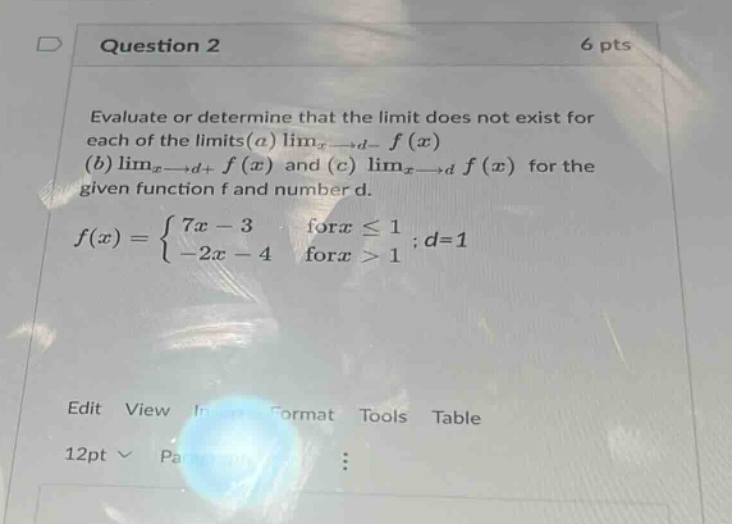
question 2 6 pts evaluate or determine that the limit does not exist for each of the limits(a) limx→d− f(x) (b) limx→d+ f(x) and (c) limx→d f(x) for the given function f and number d. f(x)={7x−3 for x≤1−2x−4 for x>1;d = 1 edit view in format tools table 12pt pa
Answer
Explanation:
Step1: Find left - hand limit
For $\lim_{x\rightarrow1^{-}}f(x)$, since $x\rightarrow1^{-}$ means $x < 1$, we use $f(x)=7x - 3$. $\lim_{x\rightarrow1^{-}}f(x)=\lim_{x\rightarrow1^{-}}(7x - 3)=7\times1-3 = 4$
Step2: Find right - hand limit
For $\lim_{x\rightarrow1^{+}}f(x)$, since $x\rightarrow1^{+}$ means $x>1$, we use $f(x)=-2x - 4$. $\lim_{x\rightarrow1^{+}}f(x)=\lim_{x\rightarrow1^{+}}(-2x - 4)=-2\times1-4=-6$
Step3: Determine the two - sided limit
Since $\lim_{x\rightarrow1^{-}}f(x)=4$ and $\lim_{x\rightarrow1^{+}}f(x)=-6$, and $\lim_{x\rightarrow1^{-}}f(x)\neq\lim_{x\rightarrow1^{+}}f(x)$, then $\lim_{x\rightarrow1}f(x)$ does not exist.
Answer:
(a) $\lim_{x\rightarrow1^{-}}f(x)=4$ (b) $\lim_{x\rightarrow1^{+}}f(x)=-6$ (c) $\lim_{x\rightarrow1}f(x)$ does not exist