question 1 of 5 select the correct answer. which statement describes the end - behavior of the given…
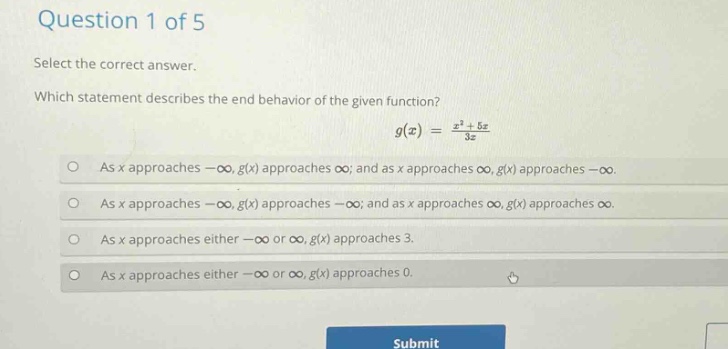
question 1 of 5 select the correct answer. which statement describes the end - behavior of the given function? g(x) = (x^3 + 5x)/3x as x approaches -∞, g(x) approaches ∞; and as x approaches ∞, g(x) approaches -∞. as x approaches -∞, g(x) approaches -∞; and as x approaches ∞, g(x) approaches ∞. as x approaches either -∞ or ∞, g(x) approaches 3. as x approaches either -∞ or ∞, g(x) approaches 0.
Answer
Explanation:
Step1: Simplify the function
First, simplify $g(x)=\frac{x^{3}+5x}{3x}$. Divide each term in the numerator by $3x$: $g(x)=\frac{x^{3}}{3x}+\frac{5x}{3x}=\frac{1}{3}x^{2}+\frac{5}{3}$.
Step2: Analyze end - behavior
For a quadratic function of the form $y = ax^{2}+bx + c$ (here $a=\frac{1}{3}$, $b = 0$, $c=\frac{5}{3}$), when $x\to\pm\infty$, the leading - term $\frac{1}{3}x^{2}$ dominates. Since $a=\frac{1}{3}>0$, as $x\to-\infty$, $y = g(x)\to\infty$ and as $x\to\infty$, $y = g(x)\to\infty$.
Answer:
As x approaches $-\infty$, $g(x)$ approaches $\infty$; and as x approaches $\infty$, $g(x)$ approaches $\infty$.