question 1 of 5\nselect the correct answer.\nwhich statement is true about the end - behavior of function…
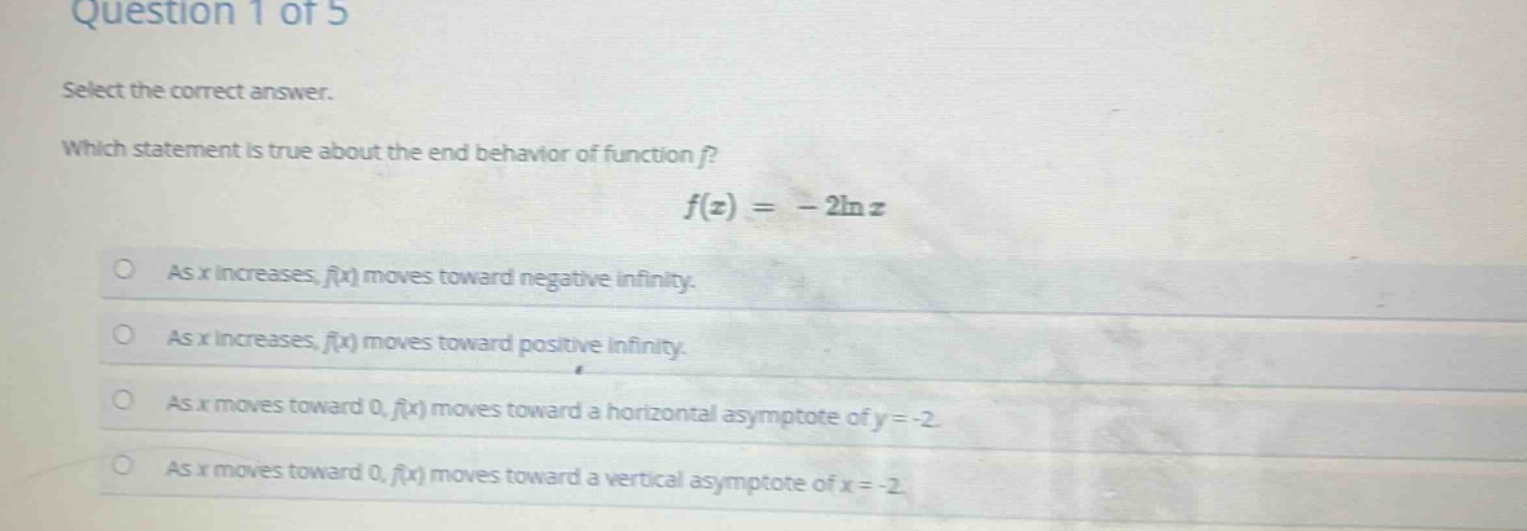
question 1 of 5\nselect the correct answer.\nwhich statement is true about the end - behavior of function f?\n$f(x)=-2ln x$\nas x increases, f(x) moves toward negative infinity.\nas x increases, f(x) moves toward positive infinity.\nas x moves toward 0, f(x) moves toward a horizontal asymptote of y = - 2.\nas x moves toward 0, f(x) moves toward a vertical asymptote of x = - 2.
Answer
Explanation:
Step1: Recall ln(x) end - behavior
The natural logarithm function (y = \ln x) has the property that as (x\to+\infty), (\ln x\to+\infty), and as (x\to0^{+}), (\ln x\to-\infty).
Step2: Analyze (y=- 2\ln x) as (x) increases
Since (\ln x\to+\infty) as (x\to+\infty), then (y =-2\ln x\to-\infty) as (x\to+\infty) because we are multiplying the positive - going (\ln x) by a negative number (-2).
Step3: Analyze (y =-2\ln x) as (x) approaches 0
As (x\to0^{+}), (\ln x\to-\infty), and (y=-2\ln x\to+\infty). The vertical asymptote of (y = \ln x) is (x = 0), and for (y=-2\ln x) it is also (x = 0), not (x=-2), and there is no horizontal asymptote of (y=-2) as (x\to0).
Answer:
As (x) increases, (f(x)) moves toward negative infinity.