this question has several parts that must be completed sequentially. if you skip a part of the question, you…
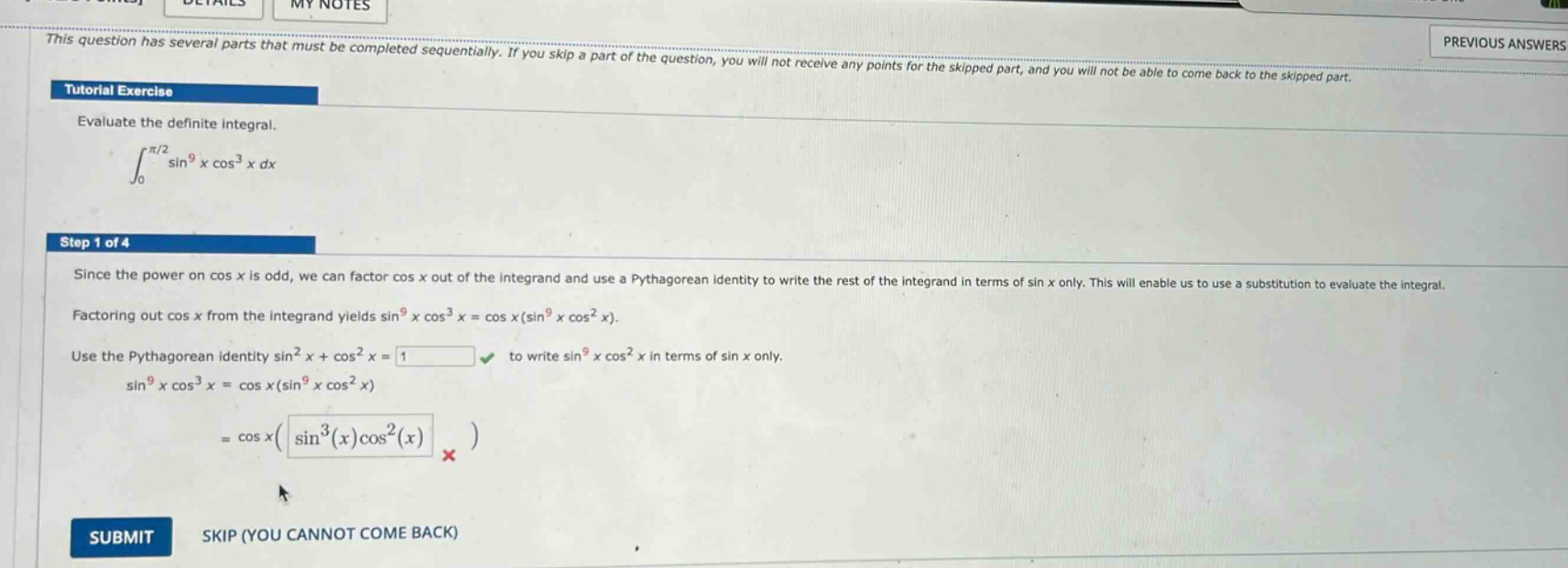
this question has several parts that must be completed sequentially. if you skip a part of the question, you will not receive any points for the skipped part, and you will not be able to come back to the skipped part. tutorial exercise evaluate the definite integral. ∫₀^(π/2) sin⁹x cos³x dx step 1 of 4 since the power on cos x is odd, we can factor cos x out of the integrand and use a pythagorean identity to write the rest of the integrand in terms of sin x only. this will enable us to use a substitution to evaluate the integral. factoring out cos x from the integrand yields sin⁹x cos³x = cos x(sin⁹x cos²x). use the pythagorean identity sin²x + cos²x = 1 to write sin⁹x cos²x in terms of sin x only. sin⁹x cos³x = cos x(sin⁹x cos²x) = cos x(sin³(x)cos²(x)) submit skip (you cannot come back)
Answer
Explanation:
Step1: Rewrite the integrand
Since $\cos^{3}x=\cos x\cos^{2}x$ and $\sin^{2}x+\cos^{2}x = 1\Rightarrow\cos^{2}x=1 - \sin^{2}x$, we have $\sin^{9}x\cos^{3}x=\sin^{9}x\cos x(1 - \sin^{2}x)$.
Step2: Use substitution
Let $u=\sin x$, then $du=\cos xdx$. When $x = 0$, $u=\sin(0)=0$; when $x=\frac{\pi}{2}$, $u=\sin(\frac{\pi}{2}) = 1$. The integral $\int_{0}^{\frac{\pi}{2}}\sin^{9}x\cos^{3}x dx$ becomes $\int_{0}^{1}u^{9}(1 - u^{2})du$.
Step3: Expand the integrand
Expand $u^{9}(1 - u^{2})=u^{9}-u^{11}$. Then $\int_{0}^{1}(u^{9}-u^{11})du=\int_{0}^{1}u^{9}du-\int_{0}^{1}u^{11}du$.
Step4: Evaluate the definite - integrals
Using the power - rule for integration $\int x^{n}dx=\frac{x^{n + 1}}{n+1}+C(n\neq - 1)$, we have $\int_{0}^{1}u^{9}du=\left[\frac{u^{10}}{10}\right]{0}^{1}=\frac{1}{10}$ and $\int{0}^{1}u^{11}du=\left[\frac{u^{12}}{12}\right]{0}^{1}=\frac{1}{12}$. So $\int{0}^{1}u^{9}du-\int_{0}^{1}u^{11}du=\frac{1}{10}-\frac{1}{12}$. Calculate $\frac{1}{10}-\frac{1}{12}=\frac{6 - 5}{60}=\frac{1}{60}$.
Answer:
$\frac{1}{60}$