question the shaded region shown below is bounded by the functions f(x)=-x² + 1.75x + 10 and g(x)=1.5x + 7…
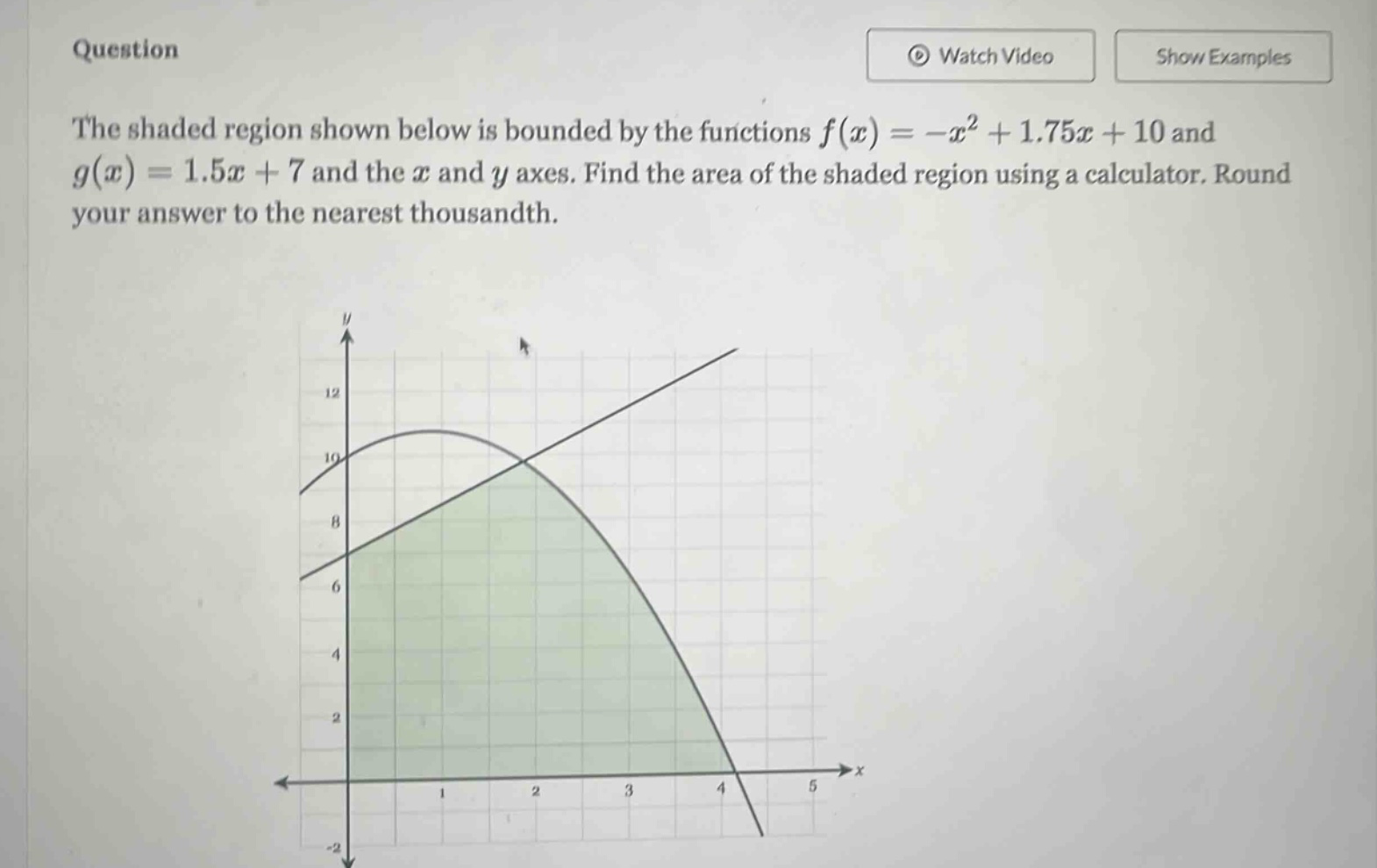
question the shaded region shown below is bounded by the functions f(x)=-x² + 1.75x + 10 and g(x)=1.5x + 7 and the x and y axes. find the area of the shaded region using a calculator. round your answer to the nearest thousandth.
Answer
Explanation:
Step1: Find intersection point
Set $f(x)=g(x)$, so $-x^{2}+1.75x + 10=1.5x + 7$. Rearranging gives $x^{2}-0.25x - 3=0$. Using the quadratic formula $x=\frac{-b\pm\sqrt{b^{2}-4ac}}{2a}$ with $a = 1$, $b=-0.25$, $c=-3$, we get $x=\frac{0.25\pm\sqrt{(-0.25)^{2}-4\times1\times(-3)}}{2\times1}=\frac{0.25\pm\sqrt{0.0625 + 12}}{2}=\frac{0.25\pm\sqrt{12.0625}}{2}$. The positive root is the relevant one for our region, $x = \frac{0.25+\sqrt{12.0625}}{2}\approx1.89$.
Step2: Set up integral for area
The area $A$ between two curves $y = f(x)$ and $y = g(x)$ from $x = 0$ to the intersection - point $x\approx1.89$ is given by $A=\int_{0}^{1.89}[(-x^{2}+1.75x + 10)-(1.5x + 7)]dx=\int_{0}^{1.89}(-x^{2}+0.25x + 3)dx$.
Step3: Integrate
Using the power - rule for integration $\int x^{n}dx=\frac{x^{n + 1}}{n+1}+C(n\neq - 1)$, we have $\int(-x^{2}+0.25x + 3)dx=-\frac{x^{3}}{3}+\frac{0.25x^{2}}{2}+3x+C$.
Step4: Evaluate definite integral
$A=\left[-\frac{x^{3}}{3}+\frac{0.25x^{2}}{2}+3x\right]_{0}^{1.89}=-\frac{(1.89)^{3}}{3}+\frac{0.25\times(1.89)^{2}}{2}+3\times1.89-0$. Using a calculator: $-\frac{(1.89)^{3}}{3}\approx-\frac{6.765}{3}\approx - 2.255$, $\frac{0.25\times(1.89)^{2}}{2}=\frac{0.25\times3.5721}{2}\approx0.447$, $3\times1.89 = 5.67$. Then $A=-2.255 + 0.447+5.67=3.862$.
Answer:
$3.862$