question show examples a polar function is given by r = f(θ) = cos(θ) - 6. as θ increases on the interval…
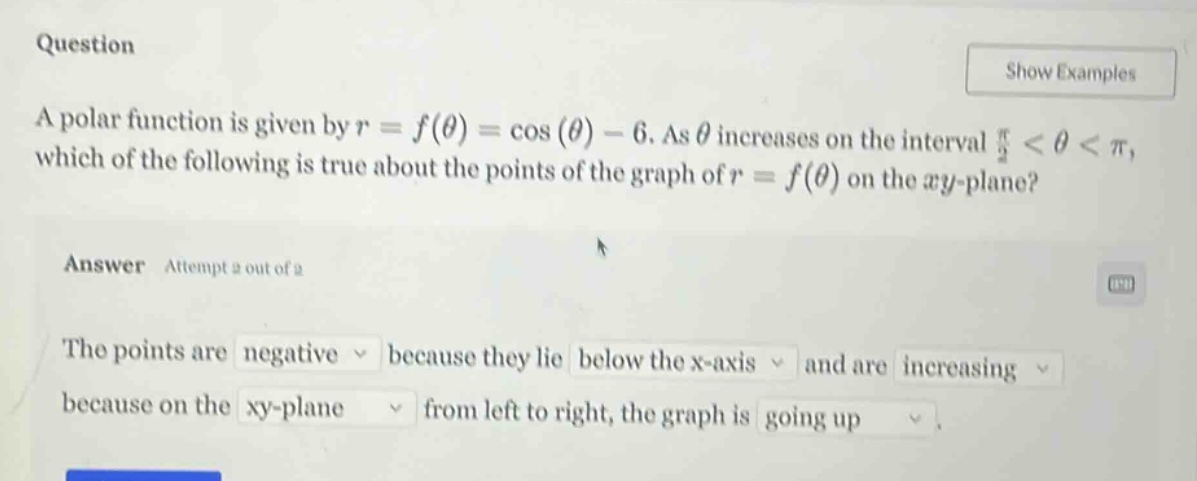
question show examples a polar function is given by r = f(θ) = cos(θ) - 6. as θ increases on the interval π/2 < θ < π, which of the following is true about the points of the graph of r = f(θ) on the xy - plane? answer attempt 2 out of 2 the points are negative because they lie below the x - axis and are increasing because on the xy - plane from left to right, the graph is going up.
Answer
Explanation:
Step1: Analyze the cosine - function behavior
We know that the cosine function $y = \cos\theta$ has the property that when $\frac{\pi}{2}<\theta<\pi$, $\cos\theta\in(- 1,0)$. Then $r=\cos\theta - 6\in(-7, - 6)$. In polar coordinates, $r$ represents the distance from the origin. A negative $r$ value means we go in the opposite direction of the terminal - side of the angle $\theta$.
Step2: Consider the sign of $r$
Since $r=\cos\theta - 6<0$ for $\frac{\pi}{2}<\theta<\pi$, the points in the $xy$ - plane corresponding to the polar points $(r,\theta)$ with $\frac{\pi}{2}<\theta<\pi$ are in the opposite direction of the terminal - side of $\theta$. Geometrically, when $\frac{\pi}{2}<\theta<\pi$, the terminal - side of $\theta$ is in the second quadrant. When $r < 0$, the points lie in the fourth quadrant (opposite of the second quadrant), which is below the $x$ - axis.
Step3: Analyze the derivative of $r$ with respect to $\theta$
Differentiate $r = f(\theta)=\cos\theta - 6$ with respect to $\theta$. Using the derivative formula $\frac{d}{d\theta}\cos\theta=-\sin\theta$. So $r'=-\sin\theta$. When $\frac{\pi}{2}<\theta<\pi$, $\sin\theta>0$, then $r'=-\sin\theta<0$. But we can also consider the behavior of the curve in the $xy$ - plane. We can convert $r = \cos\theta-6$ to rectangular coordinates using $x = r\cos\theta=(\cos\theta - 6)\cos\theta=\cos^{2}\theta-6\cos\theta$ and $y = r\sin\theta=(\cos\theta - 6)\sin\theta=\cos\theta\sin\theta-6\sin\theta$. We can also note that as $\theta$ increases from $\frac{\pi}{2}$ to $\pi$, in the $xy$ - plane, the curve is going up.
Answer:
The points are negative because they lie below the x - axis and are increasing because on the xy - plane from left to right, the graph is going up.