question 1\nthe table above gives selected values for a differentiable and increasing function f and its…
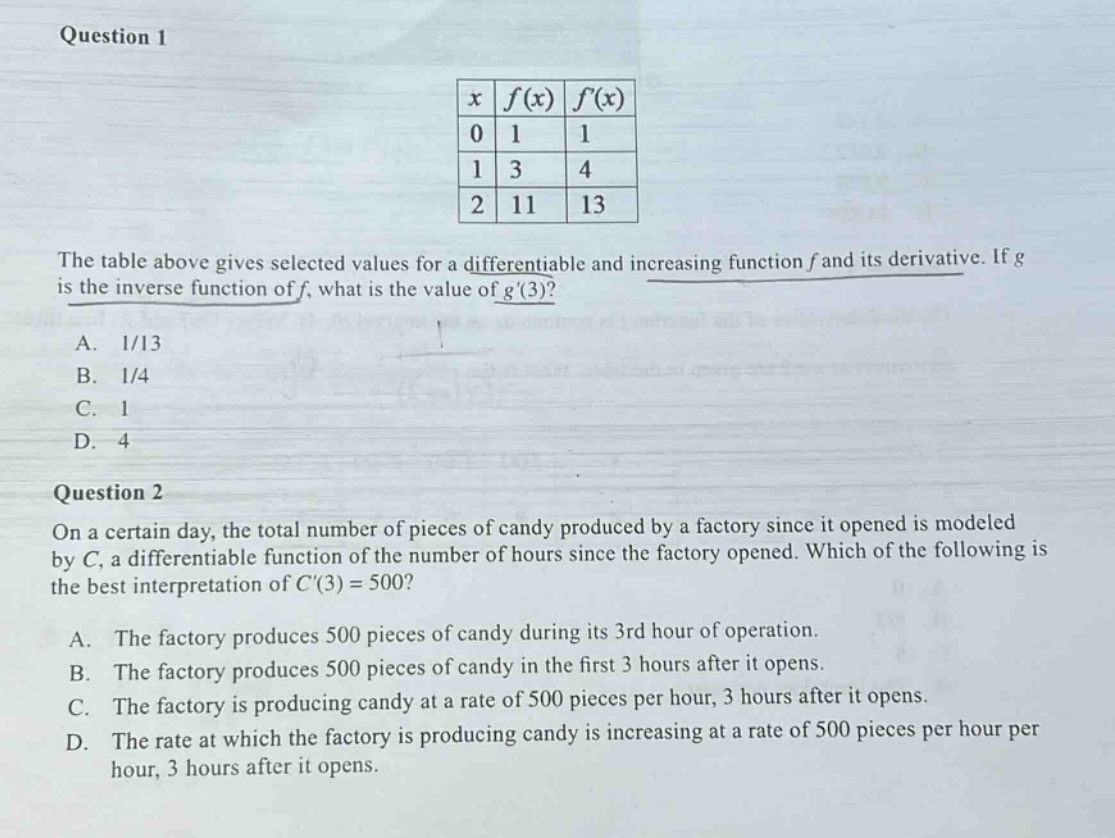
question 1\nthe table above gives selected values for a differentiable and increasing function f and its derivative. if g is the inverse function of f, what is the value of g(3)?\na. 1/13\nb. 1/4\nc. 1\nd. 4\nquestion 2\non a certain day, the total number of pieces of candy produced by a factory since it opened is modeled by c, a differentiable function of the number of hours since the factory opened. which of the following is the best interpretation of c(3) = 500?\na. the factory produces 500 pieces of candy during its 3rd hour of operation.\nb. the factory produces 500 pieces of candy in the first 3 hours after it opens.\nc. the factory is producing candy at a rate of 500 pieces per hour, 3 hours after it opens.\nd. the rate at which the factory is producing candy is increasing at a rate of 500 pieces per hour per hour, 3 hours after it opens.
Answer
Question 1
Explanation:
Step1: Use the formula for the derivative of an inverse function
If (g(x)) is the inverse function of (f(x)), then (g^{\prime}(y)=\frac{1}{f^{\prime}(x)}) where (y = f(x)). We want to find (g^{\prime}(3)). We need to find (x) such that (f(x)=3). From the table, when (x = 1), (f(1)=3).
Step2: Substitute into the formula
Since (g^{\prime}(y)=\frac{1}{f^{\prime}(x)}) and (y = 3), (x = 1), and (f^{\prime}(1)=4), then (g^{\prime}(3)=\frac{1}{f^{\prime}(1)}).
Answer:
(\frac{1}{4}), so the answer is B.
Question 2
Brief Explanations:
The derivative (C^{\prime}(t)) of a function (C(t)) (where (t) is the number of hours since the factory opened) represents the rate of change of (C) with respect to (t). When (t = 3), (C^{\prime}(3)=500) means the instantaneous rate of change of the number of candy - pieces produced with respect to time at (t = 3) hours.
Answer:
C. The factory is producing candy at a rate of 500 pieces per hour, 3 hours after it opens.