question 1: water is being pumped into an above - ground pool at a rate of 10 gallons per minute…
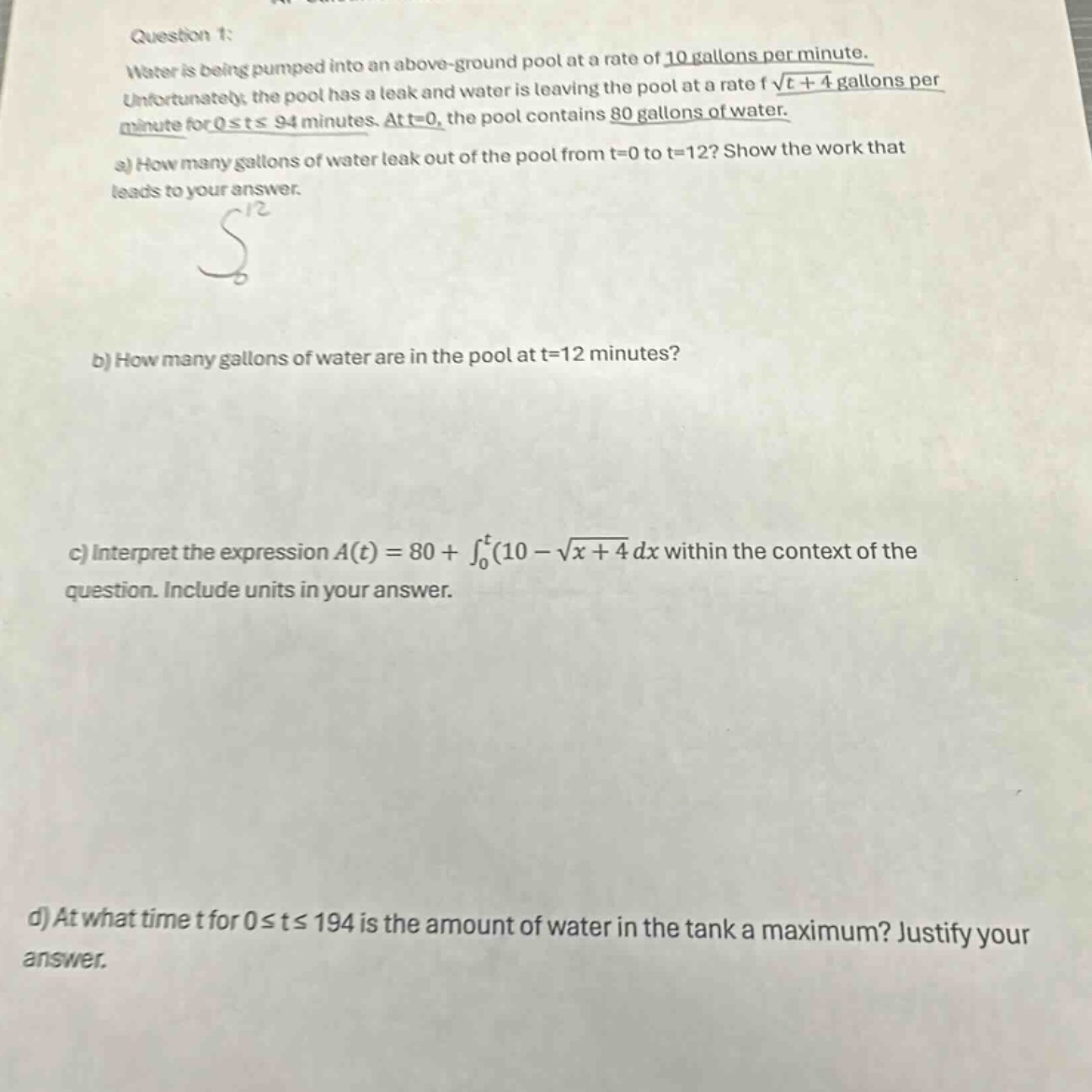
question 1: water is being pumped into an above - ground pool at a rate of 10 gallons per minute. unfortunately, the pool has a leak and water is leaving the pool at a rate of √(t + 4) gallons per minute for 0≤t≤94 minutes. at t = 0, the pool contains 80 gallons of water. a) how many gallons of water leak out of the pool from t = 0 to t = 12? show the work that leads to your answer. b) how many gallons of water are in the pool at t = 12 minutes? c) interpret the expression a(t)=80+∫₀ᵗ(10 - √(x + 4)dx within the context of the question. include units in your answer. d) at what time t for 0≤t≤194 is the amount of water in the tank a maximum? justify your answer.
Answer
Explanation:
Step1: Calculate leaked - water in part a
The rate of water leakage is $r(t)=\sqrt{t + 4}$. To find the amount of water that leaks out from $t = 0$ to $t=12$, we use the definite - integral $\int_{0}^{12}\sqrt{t + 4}dt$. Let $u=t + 4$, then $du=dt$. When $t = 0$, $u = 4$; when $t = 12$, $u = 16$. So the integral becomes $\int_{4}^{16}\sqrt{u}du=\int_{4}^{16}u^{\frac{1}{2}}du$. Using the power - rule for integration $\int x^{n}dx=\frac{x^{n + 1}}{n+1}+C(n\neq - 1)$, we have $\left[\frac{2}{3}u^{\frac{3}{2}}\right]_{4}^{16}=\frac{2}{3}(16^{\frac{3}{2}}-4^{\frac{3}{2}})=\frac{2}{3}(64 - 8)=\frac{2}{3}\times56=\frac{112}{3}\approx37.33$ gallons.
Step2: Calculate water in the pool in part b
The rate of water being pumped in is $10$ gallons per minute and the rate of leakage is $\sqrt{t + 4}$ gallons per minute. The net rate of change of water in the pool is $R(t)=10-\sqrt{t + 4}$. The initial amount of water is $80$ gallons. The amount of water in the pool at $t = 12$ is $80+\int_{0}^{12}(10-\sqrt{t + 4})dt$. We know that $\int_{0}^{12}10dt=10t\big|{0}^{12}=120$ and $\int{0}^{12}\sqrt{t + 4}dt=\frac{112}{3}$ (from part a). So the amount of water is $80 + 120-\frac{112}{3}=200-\frac{112}{3}=\frac{600 - 112}{3}=\frac{488}{3}\approx162.67$ gallons.
Step3: Interpret the expression in part c
The expression $A(t)=80+\int_{0}^{t}(10-\sqrt{x + 4})dx$. Here, $80$ is the initial amount of water in the pool (in gallons) at $t = 0$. The integral $\int_{0}^{t}(10-\sqrt{x + 4})dx$ represents the net change in the amount of water in the pool from $t = 0$ to $t=t$. The integrand $10-\sqrt{x + 4}$ is the net rate of change of the amount of water in the pool (in gallons per minute), and integrating it from $0$ to $t$ gives the total net change in the amount of water. So $A(t)$ represents the amount of water (in gallons) in the pool at time $t$ (in minutes).
Step4: Find the maximum in part d
The amount of water in the pool is $A(t)=80+\int_{0}^{t}(10-\sqrt{x + 4})dx$. The derivative of $A(t)$ using the fundamental theorem of calculus is $A^\prime(t)=10-\sqrt{t + 4}$. To find the critical points, set $A^\prime(t)=0$. So $10-\sqrt{t + 4}=0$, which gives $\sqrt{t + 4}=10$. Squaring both sides, we get $t + 4 = 100$, so $t = 96$. We also need to check the endpoints $t = 0$ and $t = 194$. $A(0)=80$ gallons. $A(96)=80+\int_{0}^{96}(10-\sqrt{x + 4})dx$. First, $\int_{0}^{96}(10-\sqrt{x + 4})dx=\int_{0}^{96}10dx-\int_{0}^{96}\sqrt{x + 4}dx$. $\int_{0}^{96}10dx=10x\big|{0}^{96}=960$. Let $u=x + 4$, then $\int{0}^{96}\sqrt{x + 4}dx=\int_{4}^{100}\sqrt{u}du=\left[\frac{2}{3}u^{\frac{3}{2}}\right]{4}^{100}=\frac{2}{3}(1000 - 8)=\frac{1984}{3}$. So $A(96)=80+960-\frac{1984}{3}=\frac{240 + 2880-1984}{3}=\frac{1136}{3}\approx378.67$ gallons. $A(194)=80+\int{0}^{194}(10-\sqrt{x + 4})dx$. $\int_{0}^{194}10dx = 1940$. Let $u=x + 4$, then $\int_{0}^{194}\sqrt{x + 4}dx=\int_{4}^{198}\sqrt{u}du=\left[\frac{2}{3}u^{\frac{3}{2}}\right]_{4}^{198}$. Since $A^\prime(t)=10-\sqrt{t + 4}$, for $t\lt96$, $A^\prime(t)>0$ (the function is increasing), and for $t>96$, $A^\prime(t)<0$ (the function is decreasing). So the amount of water in the pool is maximum at $t = 96$ minutes.
Answer:
a) $\frac{112}{3}$ gallons b) $\frac{488}{3}$ gallons c) $A(t)$ represents the amount of water (in gallons) in the pool at time $t$ (in minutes), where $80$ is the initial amount of water, and $\int_{0}^{t}(10-\sqrt{x + 4})dx$ is the net change in the amount of water from $t = 0$ to $t=t$. d) $t = 96$ minutes. Justification: $A^\prime(t)=10-\sqrt{t + 4}$, critical point at $t = 96$, $A^\prime(t)>0$ for $t\lt96$ and $A^\prime(t)<0$ for $t>96$.