question\nwrite the equation of the trigonometric function shown in the graph.\ntry\n$y=squaresin(square…
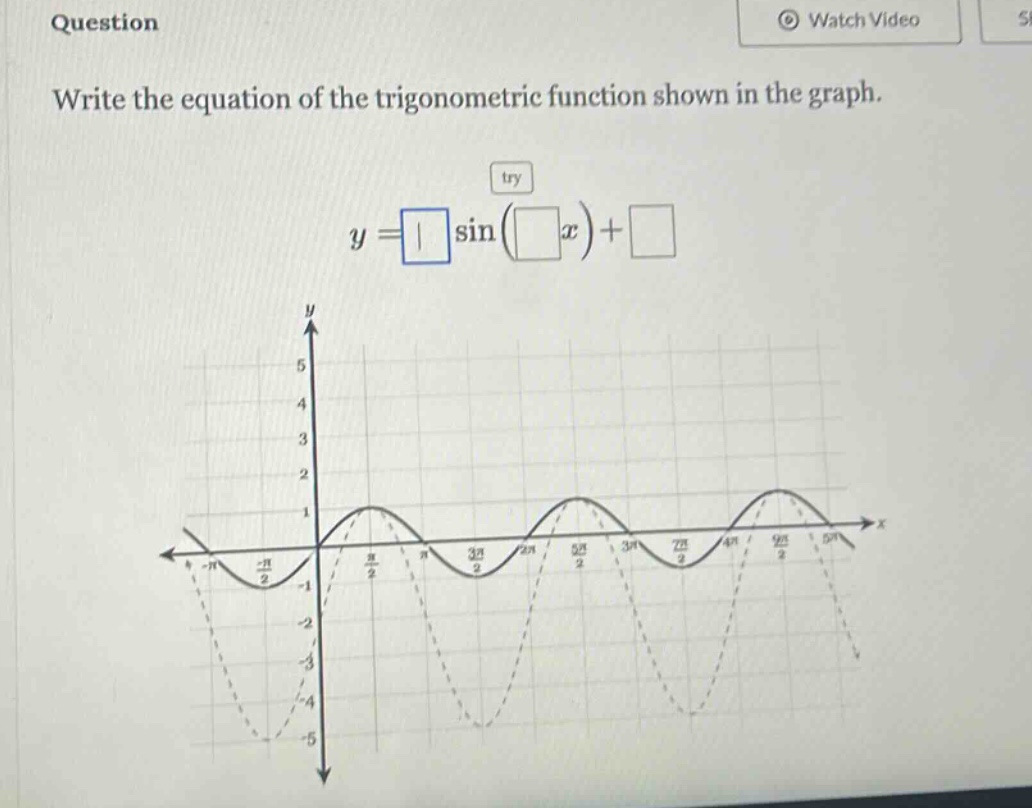
question\nwrite the equation of the trigonometric function shown in the graph.\ntry\n$y=squaresin(square x)+square$
Answer
Explanation:
Step1: Determine the amplitude
The amplitude $A$ of a sine - function $y = A\sin(Bx)+C$ is half the vertical distance between the maximum and minimum values. The maximum value of the function is $y = 1$ and the minimum value is $y=-1$. So, $A=\frac{1 - (- 1)}{2}=1$.
Step2: Determine the period and find $B$
The period $T$ of a sine - function $y = A\sin(Bx)+C$ is given by $T=\frac{2\pi}{B}$. The distance between two consecutive peaks (or troughs) is the period. From the graph, the period $T = 2\pi$. Since $T=\frac{2\pi}{B}$ and $T = 2\pi$, then $B = 1$.
Step3: Determine the vertical shift
The mid - line of the function is $y = 0$. For the general form $y=A\sin(Bx)+C$, the vertical shift is $C$. Since the mid - line of the given function is $y = 0$, then $C = 0$.
Answer:
$y = 1\sin(1x)+0$ or simply $y=\sin(x)$