questions 1 through 3 refer to the following. let $r = f(\theta)$ be a polar function in the polar…
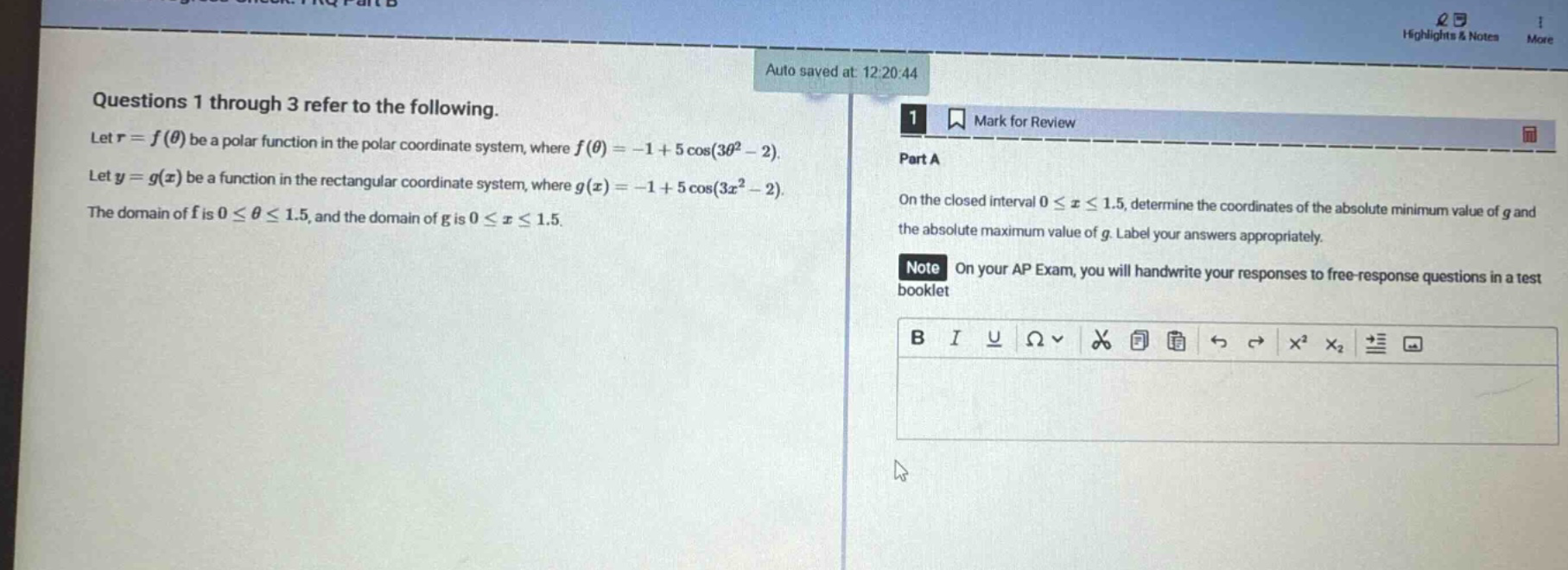
questions 1 through 3 refer to the following. let $r = f(\theta)$ be a polar function in the polar coordinate system, where $f(\theta)=-1 + 5cos(3\theta^{2}-2)$. let $y = g(x)$ be a function in the rectangular coordinate system, where $g(x)=-1 + 5cos(3x^{2}-2)$. the domain of $f$ is $0leq\thetaleq1.5$, and the domain of $g$ is $0leq xleq1.5$. part a on the closed interval $0leq xleq1.5$, determine the coordinates of the absolute minimum value of $g$ and the absolute maximum value of $g$. label your answers appropriately. note on your ap exam, you will handwrite your responses to free - response questions in a test booklet
Answer
Explanation:
Step1: Find the derivative of (g(x))
Using the chain - rule, if (y = - 1+5\cos(u)) and (u = 3x^{2}-2), then (\frac{dy}{du}=-5\sin(u)) and (\frac{du}{dx} = 6x). So (g^\prime(x)=\frac{dy}{dx}=\frac{dy}{du}\cdot\frac{du}{dx}=-30x\sin(3x^{2}-2)).
Step2: Find the critical points
Set (g^\prime(x) = 0). Since (g^\prime(x)=-30x\sin(3x^{2}-2)=0), we have two cases: Case 1: (x = 0) (because if (x = 0), then (-30x\sin(3x^{2}-2)=0)). Case 2: (\sin(3x^{2}-2)=0). Then (3x^{2}-2 = k\pi), (k\in\mathbb{Z}). For (0\leq x\leq1.5), when (k = 0), (3x^{2}-2=0), so (x=\sqrt{\frac{2}{3}}\approx0.82).
Step3: Evaluate (g(x)) at critical points and endpoints
- Evaluate (g(x)) at (x = 0): (g(0)=-1 + 5\cos(-2)\approx-1+5\times(-0.416)=-1 - 2.08=-3.08).
- Evaluate (g(x)) at (x=\sqrt{\frac{2}{3}}): (g(\sqrt{\frac{2}{3}})=-1 + 5\cos(0)=-1 + 5=4).
- Evaluate (g(x)) at (x = 1.5): (g(1.5)=-1+5\cos(3\times(1.5)^{2}-2)=-1 + 5\cos(4.75)\approx-1+5\times(-0.58)=-1 - 2.9=-3.9).
Answer:
The absolute minimum value of (g(x)) on the interval ([0,1.5]) is (-3.9) at (x = 1.5), and the absolute maximum value of (g(x)) on the interval ([0,1.5]) is (4) at (x=\sqrt{\frac{2}{3}}).