what radical function is represented in the graph?\n$f(x)=\\square$\n(simplify your answer.)
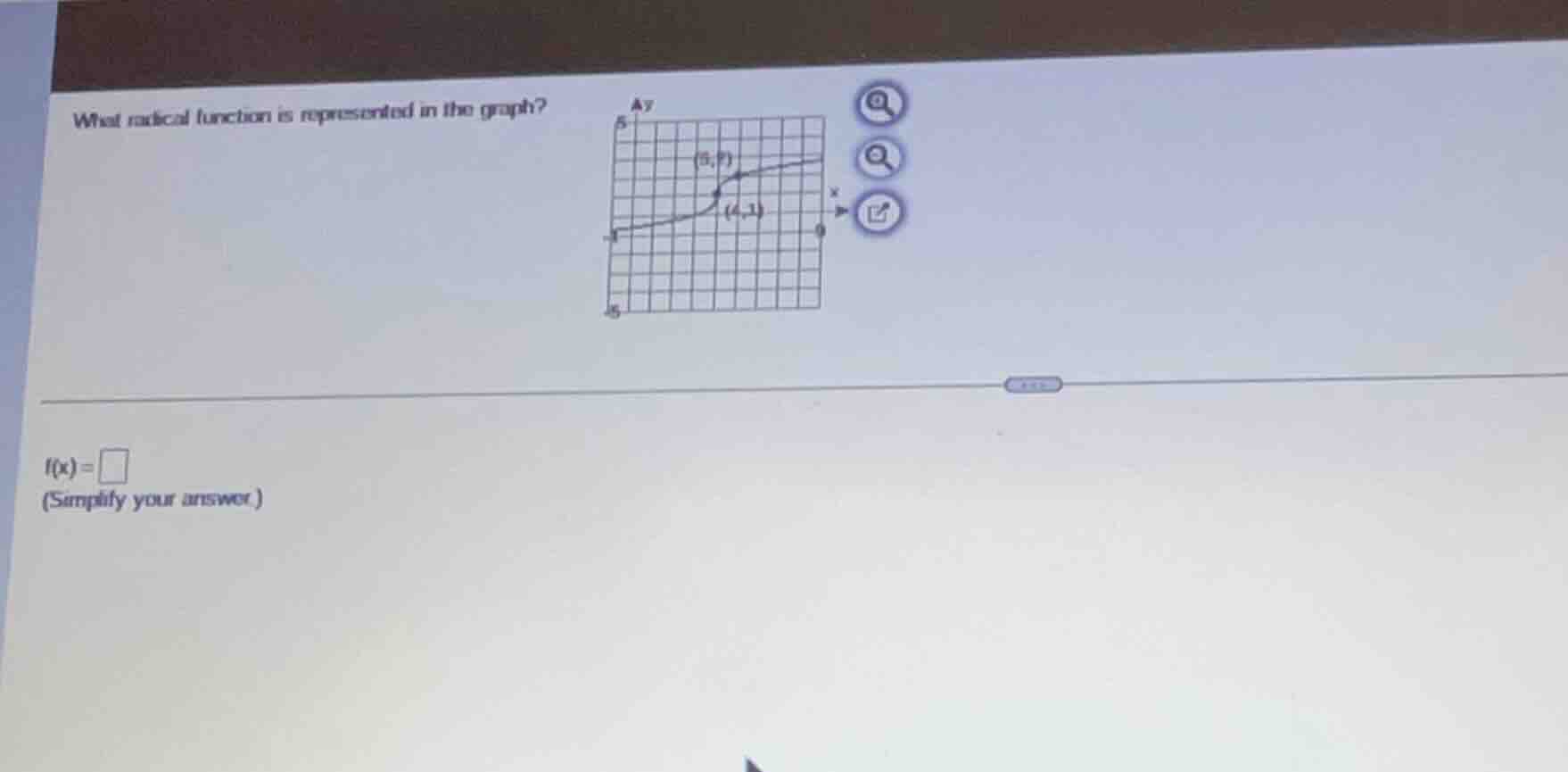
what radical function is represented in the graph?\n$f(x)=\\square$\n(simplify your answer.)
Answer
Explanation:
Step1: Identify the parent function form
Radical functions often have the form ( f(x) = \sqrt{x - h} + k ), where ((h, k)) is the starting point (vertex) of the radical part. From the graph, the point ((4, 1)) seems to be the vertex of the radical part (the point where the graph starts to curve more steeply, like the vertex of a square - root function). So ( h = 4 ) and ( k = 1 ), so the function has the form ( f(x)=\sqrt{x - 4}+1 ).
Step2: Verify with another point
We can check with the point ((5, 2)). Substitute ( x = 5 ) into the function ( f(x)=\sqrt{5 - 4}+1=\sqrt{1}+1 = 1 + 1=2 ), which matches the ( y ) - value of the point ((5, 2)). Also, when ( x = 4 ), ( f(4)=\sqrt{4 - 4}+1=0 + 1 = 1 ), which matches the point ((4, 1)). And when ( x=0 ), let's see the left - most point. If we assume the left - most point is when the non - radical part (if any) is considered, but from the form we have, when ( x\geq4 ), the radical is defined. But the graph also has a horizontal part to the left of ( x = 4 ). Wait, maybe the function is a square - root function shifted right by 4 units and up by 1 unit. The left - hand part (for ( x<4 )) seems to be a horizontal line? Wait, no, looking at the graph, the point ((0, - 1))? Wait, no, the grid: let's re - examine. The graph has a point ((4,1)) and ((5,2)), and the left - most part: if we consider the function ( f(x)=\sqrt{x - 4}+1 ), for ( x = 4 ), ( f(4)=1 ), for ( x = 5 ), ( f(5)=2 ), and for ( x ) values less than 4, if we assume that the function is a horizontal line? Wait, no, maybe the initial part (before ( x = 4 )) is a horizontal line ( y = 1 )? But the radical function starts at ( x = 4 ). Wait, no, the general form of a square - root function is ( y=\sqrt{x - h}+k ), with domain ( x\geq h ). But the graph shows a curve that starts at ( (4,1) ) and goes up, and to the left of ( x = 4 ), it's a horizontal line? Wait, maybe the function is ( f(x)=\sqrt{x - 4}+1 ) for ( x\geq4 ) and a constant function for ( x<4 ), but since the problem says "radical function", we focus on the radical part. Since the point ((4,1)) and ((5,2)) fit ( f(x)=\sqrt{x - 4}+1 ), and the left - hand part might be a horizontal segment (maybe the function is defined as ( f(x)=\sqrt{x - 4}+1 ) for ( x\geq4 ) and ( f(x)=1 ) for ( x<4 ), but the radical part is ( \sqrt{x - 4}+1 )).
Answer:
( f(x)=\sqrt{x - 4}+1 )