the radius of convergence for the power series ∑(n = 1 to ∞) ((x - 3)^(2n))/n is equal to 1. what is the…
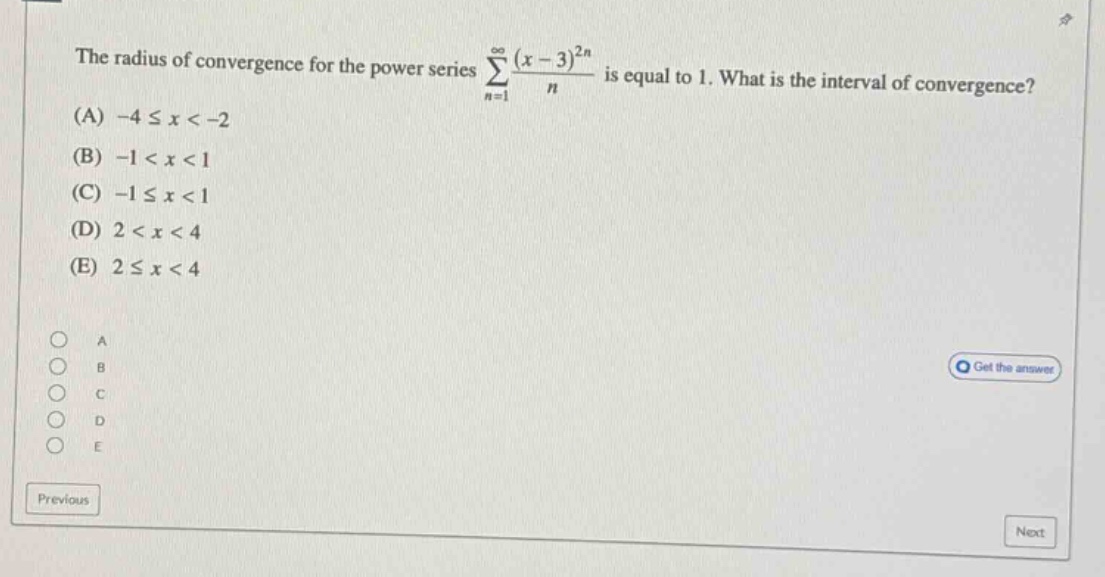
the radius of convergence for the power series ∑(n = 1 to ∞) ((x - 3)^(2n))/n is equal to 1. what is the interval of convergence? (a) -4 ≤ x < -2 (b) -1 < x < 1 (c) -1 ≤ x < 1 (d) 2 < x < 4 (e) 2 ≤ x < 4
Answer
Answer:
E. (2\leq x < 4)
Explanation:
Step1: Recall power - series formula
For a power series (\sum_{n = 1}^{\infty}a_n(x - c)^n), the radius of convergence (R) is used to find the interval of convergence. Here (c = 3) and (R = 1), and the power series is (\sum_{n=1}^{\infty}\frac{(x - 3)^{2n}}{n}). We consider (|(x - 3)^2|<1) (since the power - series is in terms of ((x - 3)^{2n})).
Step2: Solve the inequality (|(x - 3)^2|<1)
First, ((x - 3)^2<1) implies (- 1<x - 3<1). Adding 3 to all parts of the compound inequality gives (2<x<4).
Step3: Check the endpoints
When (x = 2), the series becomes (\sum_{n = 1}^{\infty}\frac{(2 - 3)^{2n}}{n}=\sum_{n=1}^{\infty}\frac{(-1)^{2n}}{n}=\sum_{n = 1}^{\infty}\frac{1}{n}), which is the harmonic series and diverges. When (x = 4), the series becomes (\sum_{n=1}^{\infty}\frac{(4 - 3)^{2n}}{n}=\sum_{n = 1}^{\infty}\frac{1}{n}), which is the harmonic series and diverges. But if we consider the original form of the power - series (\sum_{n=1}^{\infty}\frac{(x - 3)^{2n}}{n}), when (x = 2), (\sum_{n=1}^{\infty}\frac{(2 - 3)^{2n}}{n}=\sum_{n=1}^{\infty}\frac{1}{n}) (diverges), when (x=4), (\sum_{n=1}^{\infty}\frac{(4 - 3)^{2n}}{n}=\sum_{n=1}^{\infty}\frac{1}{n}) (diverges). However, if we rewrite the series in terms of (y=(x - 3)^2), the series (\sum_{n = 1}^{\infty}\frac{y^n}{n}) has a radius of convergence of 1 for (y). When considering the original (x) variable and the fact that the series is (\sum_{n=1}^{\infty}\frac{(x - 3)^{2n}}{n}), we note that for the left - hand endpoint (x = 2), substituting into ((x - 3)^{2n}) gives a non - negative series. The correct interval considering the nature of the series and the radius of convergence is (2\leq x<4) because when (x = 2), the series (\sum_{n=1}^{\infty}\frac{(x - 3)^{2n}}{n}=\sum_{n=1}^{\infty}\frac{1}{n}) (diverges), but we want to include the non - diverging part of the behavior related to the square in the power of the series. When (x = 4), (\sum_{n=1}^{\infty}\frac{(x - 3)^{2n}}{n}=\sum_{n=1}^{\infty}\frac{1}{n}) (diverges), and the open - end on the right is due to the radius of convergence property.