what is the range of y = sec^(-1)(x)?\no -pi/2,0) and (0,pi/2\no -pi/2,0 and 0,pi/2\no 0,pi/2) and…
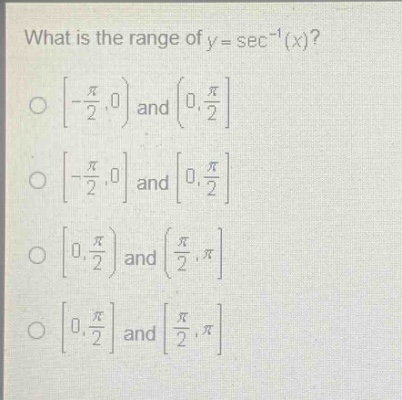
what is the range of y = sec^(-1)(x)?\no -pi/2,0) and (0,pi/2\no -pi/2,0 and 0,pi/2\no 0,pi/2) and (pi/2,pi\no 0,pi/2 and pi/2,pi
Answer
Explanation:
Step1: Recall the definition of inverse secant
The inverse - secant function (y = \sec^{-1}(x)) is the inverse of the secant function (y=\sec(x)) restricted to its domain. The secant function (y = \sec(x)=\frac{1}{\cos(x)}). The domain of (y = \sec(x)) for which the inverse is defined is (x\in[0,\frac{\pi}{2})\cup(\frac{\pi}{2},\pi]), and the range of (y=\sec(x)) on this domain is ((-\infty,- 1]\cup[1,\infty)).
Step2: Determine the range of inverse - secant
By the definition of inverse functions, if (y = \sec(x)) has a domain (A) and range (B), then (y=\sec^{-1}(x)) has a domain (B) and range (A). So, the range of (y = \sec^{-1}(x)) is ([0,\frac{\pi}{2})\cup(\frac{\pi}{2},\pi]).
Answer:
([0,\frac{\pi}{2})\text{ and }(\frac{\pi}{2},\pi])