the rate of change of the function (f(x)=sec x+cos x) is given by the expression (sec x\tan x - sin x). show…
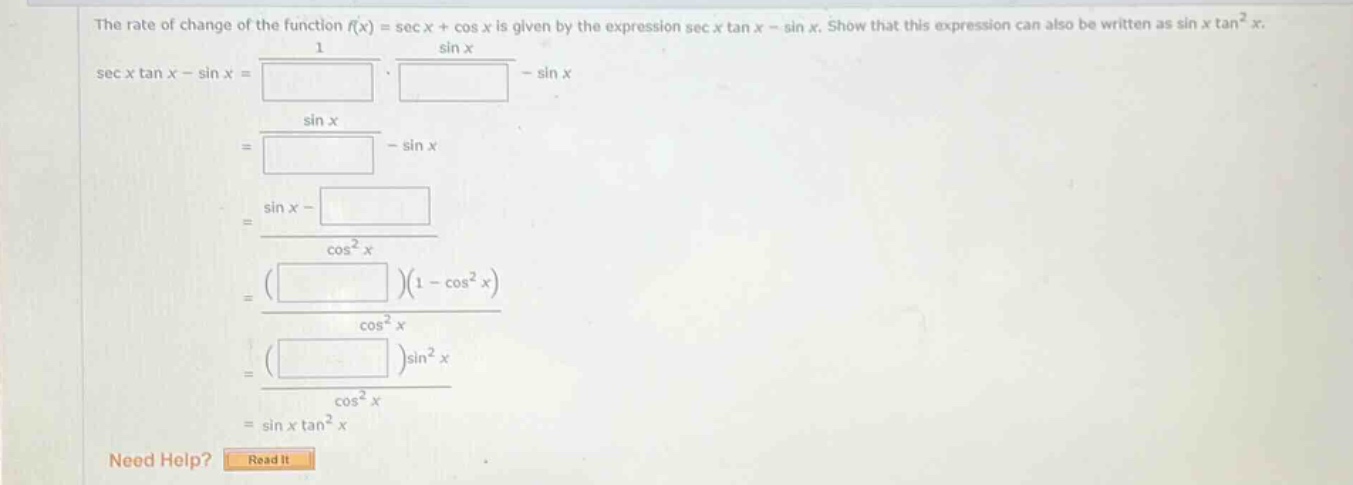
the rate of change of the function (f(x)=sec x+cos x) is given by the expression (sec x\tan x - sin x). show that this expression can also be written as (sin x\tan^{2}x).\n(sec x\tan x-sin x=\frac{1}{square}cdot\frac{sin x}{square}-sin x)\n(=\frac{sin x}{square}-sin x)\n(=\frac{sin x - square}{cos^{2}x})\n(=\frac{(square)(1 - cos^{2}x)}{cos^{2}x})\n(=\frac{(square)sin^{2}x}{cos^{2}x})\n(=sin x\tan^{2}x)\nneed help? read it
Answer
Explanation:
Step1: Rewrite secant and tangent
Recall $\sec x=\frac{1}{\cos x}$ and $\tan x = \frac{\sin x}{\cos x}$. So $\sec x\tan x-\sin x=\frac{1}{\cos x}\cdot\frac{\sin x}{\cos x}-\sin x$.
Step2: Simplify the first - term product
$\frac{1}{\cos x}\cdot\frac{\sin x}{\cos x}-\sin x=\frac{\sin x}{\cos^{2}x}-\sin x$.
Step3: Get a common denominator
To subtract, we rewrite $\sin x$ with a denominator of $\cos^{2}x$. So $\frac{\sin x}{\cos^{2}x}-\sin x=\frac{\sin x-\sin x\cos^{2}x}{\cos^{2}x}$.
Step4: Factor out sin x
Factor out $\sin x$ from the numerator: $\frac{\sin x-\sin x\cos^{2}x}{\cos^{2}x}=\frac{\sin x(1 - \cos^{2}x)}{\cos^{2}x}$.
Step5: Use the Pythagorean identity
Since $1-\cos^{2}x=\sin^{2}x$, we have $\frac{\sin x(1 - \cos^{2}x)}{\cos^{2}x}=\frac{\sin x\cdot\sin^{2}x}{\cos^{2}x}$.
Step6: Rewrite in terms of tangent
Recall $\tan x=\frac{\sin x}{\cos x}$, so $\frac{\sin x\cdot\sin^{2}x}{\cos^{2}x}=\sin x\cdot\frac{\sin^{2}x}{\cos^{2}x}=\sin x\tan^{2}x$.
Answer:
We have shown that $\sec x\tan x-\sin x=\sin x\tan^{2}x$ by using trigonometric identities and algebraic manipulations.