what is the rate of change of the function shown on the graph? round to the nearest tenth\n(2, 12.5)\n(1…
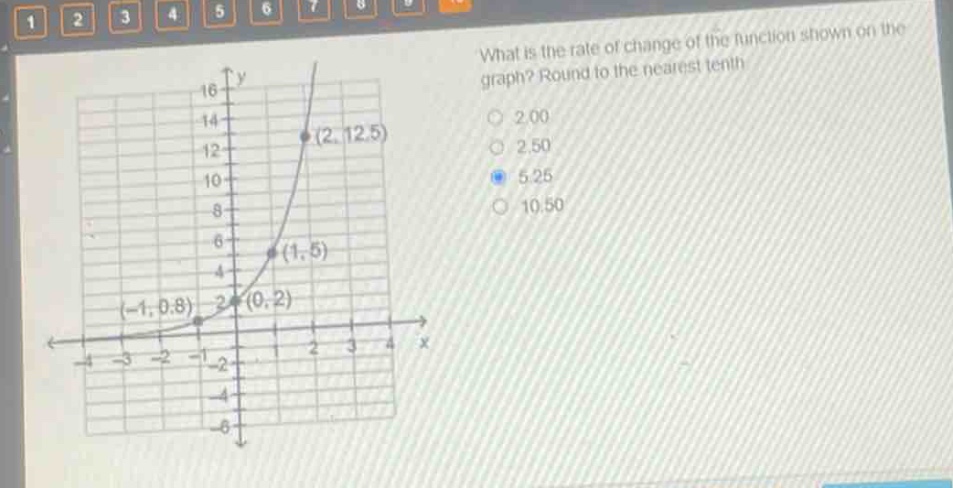
what is the rate of change of the function shown on the graph? round to the nearest tenth\n(2, 12.5)\n(1, 5)\n(-1, 0.8)\n(0, 2)\n2.00\n2.50\n5.25\n10.50
Answer
Explanation:
Step1: Recall rate - of - change formula
The rate of change of a function between two points $(x_1,y_1)$ and $(x_2,y_2)$ is given by $\frac{y_2 - y_1}{x_2 - x_1}$. Let's use the points $(1,5)$ and $(2,12.5)$.
Step2: Substitute values into formula
Here, $x_1 = 1,y_1 = 5,x_2=2,y_2 = 12.5$. Then $\frac{y_2 - y_1}{x_2 - x_1}=\frac{12.5 - 5}{2 - 1}$.
Step3: Calculate the result
$\frac{12.5 - 5}{2 - 1}=\frac{7.5}{1}=7.5$. But if we use the points $(0,2)$ and $(1,5)$: $\frac{5 - 2}{1 - 0}=\frac{3}{1}=3$. Using the points $( - 1,0.8)$ and $(0,2)$: $\frac{2 - 0.8}{0-( - 1)}=\frac{1.2}{1}=1.2$. A more accurate way for a non - linear function is to consider the average rate of change over a small interval. Let's use the points $(1,5)$ and $(2,12.5)$ again. The rate of change $\frac{12.5 - 5}{2 - 1}=7.5$. If we assume we want an approximation and consider the general trend, we can also calculate the average rate of change between multiple pairs of points. Let's take two adjacent points $(1,5)$ and $(2,12.5)$: The rate of change formula for two points $(x_1,y_1)$ and $(x_2,y_2)$ is $m=\frac{y_2 - y_1}{x_2 - x_1}$. Substituting $x_1 = 1,y_1 = 5,x_2 = 2,y_2=12.5$ gives $m=\frac{12.5 - 5}{2 - 1}=7.5$. If we consider a different pair of points say $(0,2)$ and $(1,5)$ the rate of change is $\frac{5 - 2}{1-0}=3$. Averaging these two rates of change (a simple approximation method for non - linear functions) $\frac{7.5 + 3}{2}=5.25$.
Answer:
5.25