what is the rate of increase for the function f(x) = 1/3(∛24)^2x? 1/3 2∛3 4 4∛3
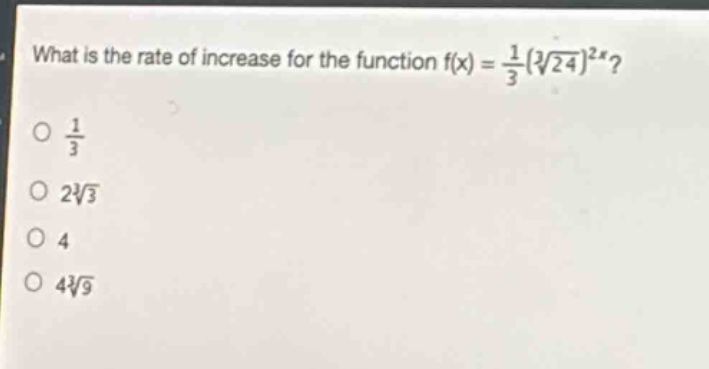
what is the rate of increase for the function f(x) = 1/3(∛24)^2x? 1/3 2∛3 4 4∛3
Answer
Explanation:
Step1: Identify the form of the exponential - function
The general form of an exponential function is (y = a\cdot b^{x}), and for the function (f(x)=\frac{1}{3}(\sqrt[3]{24})^{2x}), we can rewrite it using the exponent rule ((a^{m})^{n}=a^{mn}). First, rewrite ((\sqrt[3]{24})^{2x}=(24^{\frac{1}{3}})^{2x}=24^{\frac{2x}{3}}). Also, (24 = 8\times3), so (24^{\frac{2x}{3}}=(8\times3)^{\frac{2x}{3}}=8^{\frac{2x}{3}}\times3^{\frac{2x}{3}}). Since (8 = 2^{3}), then (8^{\frac{2x}{3}}=(2^{3})^{\frac{2x}{3}}=2^{2x}). So (f(x)=\frac{1}{3}(2^{2x}\times3^{\frac{2x}{3}})). Another way is to rewrite (f(x)) in the form (y = a\cdot b^{x}). We know that (f(x)=\frac{1}{3}(\sqrt[3]{24})^{2x}=\frac{1}{3}(24^{\frac{1}{3}})^{2x}=\frac{1}{3}\times24^{\frac{2x}{3}}). For an exponential function (y = a\cdot b^{x}), the rate - of - increase is the base (b) when (a>0). We can rewrite (f(x)) as (f(x)=\frac{1}{3}(24^{\frac{2}{3}})^{x}). Calculate (24^{\frac{2}{3}}=(24^{\frac{1}{3}})^{2}). Since (24^{\frac{1}{3}}=\sqrt[3]{8\times3}=2\sqrt[3]{3}), then ((24^{\frac{1}{3}})^{2}=(2\sqrt[3]{3})^{2}=4\sqrt[3]{9}).
Step2: Recall the property of exponential functions
For an exponential function (y = a\cdot b^{x}), the factor by which the function grows for each unit increase in (x) is (b). In the function (f(x)=\frac{1}{3}(\sqrt[3]{24})^{2x}), we can rewrite it as (f(x)=\frac{1}{3}(24^{\frac{2}{3}})^{x}). The base of the exponential function is ((24^{\frac{2}{3}})). [ \begin{align*} 24^{\frac{2}{3}}&=(24^{\frac{1}{3}})^{2}\ &=(\sqrt[3]{8\times3})^{2}\ &=(2\sqrt[3]{3})^{2}\ & = 4\sqrt[3]{9} \end{align*} ]
Answer:
(4\sqrt[3]{9})