what is the rate of increase for the function f(x) = $\frac{1}{3}(sqrt3{24})^{2x}$?\n$\frac{1}{3}$\n$2sqrt3{3…
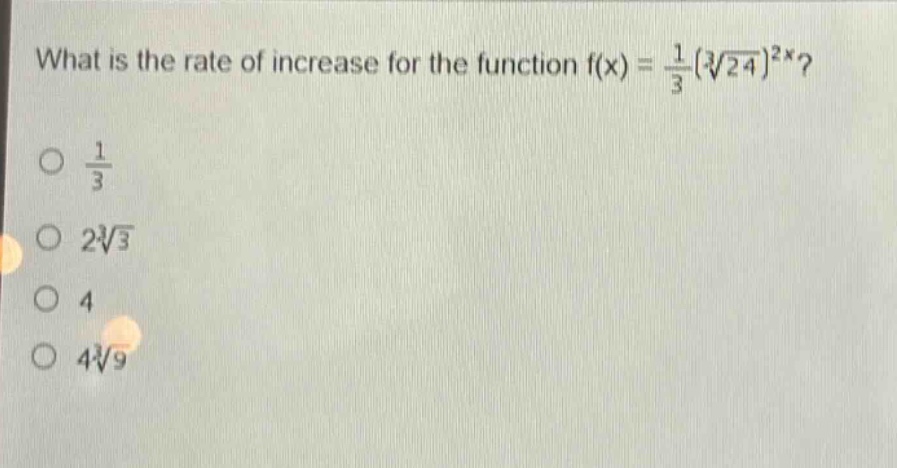
what is the rate of increase for the function f(x) = $\frac{1}{3}(sqrt3{24})^{2x}$?\n$\frac{1}{3}$\n$2sqrt3{3}$\n4\n$4sqrt3{9}$
Answer
Answer:
D. $4\sqrt[3]{9}$
Explanation:
Step1: Recall exponential - function form
The general form of an exponential function is $y = ab^{x}$, and its derivative (rate of change) is $y^\prime=ab^{x}\ln(b)$. For the function $f(x)=\frac{1}{3}(\sqrt[3]{24})^{2x}$, we can rewrite it as $f(x)=\frac{1}{3}(24^{\frac{1}{3}})^{2x}=\frac{1}{3}(24)^{\frac{2x}{3}}$, where $a = \frac{1}{3}$ and $b = 24^{\frac{2}{3}}$.
Step2: Calculate the derivative
Using the formula $y^\prime=ab^{x}\ln(b)$, for $y = f(x)=\frac{1}{3}(24)^{\frac{2x}{3}}$, we have $y^\prime=\frac{1}{3}\times(24)^{\frac{2x}{3}}\times\ln(24^{\frac{2}{3}})$. The rate - of - increase of the exponential function $y = f(x)$ is given by the coefficient of the non - exponential part when considering the derivative at a general point. First, simplify $24^{\frac{2}{3}}=(8\times3)^{\frac{2}{3}}=(8)^{\frac{2}{3}}\times(3)^{\frac{2}{3}} = 4\sqrt[3]{9}$. The rate of increase of the function $y = f(x)$ (the base of the exponential part of the derivative) is $24^{\frac{2}{3}}=4\sqrt[3]{9}$.