the rate of people entering a subway car on a particular day is modeled by the function $r$, where…
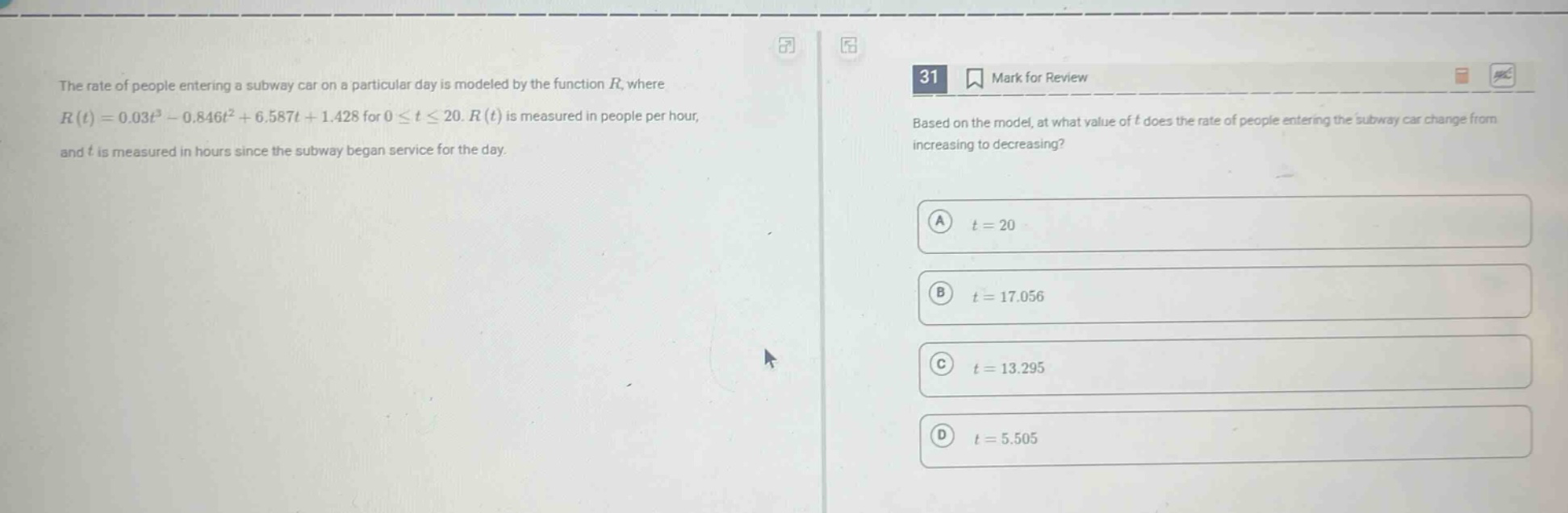
the rate of people entering a subway car on a particular day is modeled by the function $r$, where $r(t)=0.03t^{3}-0.846t^{2}+6.587t + 1.428$ for $0leq tleq20$. $r(t)$ is measured in people per hour, and $t$ is measured in hours since the subway began service for the day. based on the model, at what value of $t$ does the rate of people entering the subway car change from increasing to decreasing? a $t = 20$ b $t = 17.056$ c $t = 13.295$ d $t = 5.505$
Answer
Answer:
C. $t = 13.295$
Explanation:
Step1: Find the derivative of $R(t)$
$R(t)=0.03t^{3}-0.846t^{2}+6.587t + 1.428$, so $R'(t)=0.09t^{2}-1.692t + 6.587$.
Step2: Find the critical points
Set $R'(t) = 0$. Using the quadratic formula $t=\frac{-b\pm\sqrt{b^{2}-4ac}}{2a}$ for $at^{2}+bt + c = 0$. Here $a = 0.09$, $b=-1.692$, $c = 6.587$. $t=\frac{1.692\pm\sqrt{(-1.692)^{2}-4\times0.09\times6.587}}{2\times0.09}=\frac{1.692\pm\sqrt{2.862864 - 2.37132}}{0.18}=\frac{1.692\pm\sqrt{0.491544}}{0.18}=\frac{1.692\pm0.7011}{0.18}$. We get $t_1=\frac{1.692 + 0.7011}{0.18}\approx13.295$ and $t_2=\frac{1.692- 0.7011}{0.18}\approx5.505$.
Step3: Determine the nature of the critical points
Take the second - derivative $R''(t)=0.18t-1.692$. For $t = 5.505$, $R''(5.505)=0.18\times5.505-1.692=0.9909 - 1.692=- 0.7011<0$, the function $R(t)$ is decreasing at this point. For $t = 13.295$, $R''(13.295)=0.18\times13.295-1.692 = 2.3931-1.692 = 0.7011>0$, the function $R(t)$ is increasing before this point and decreasing after this point. So the rate of people entering the subway car changes from increasing to decreasing at $t = 13.295$.