if f(x) is a rational function and has a vertical asymptote at x = 1, which of the following statements must…
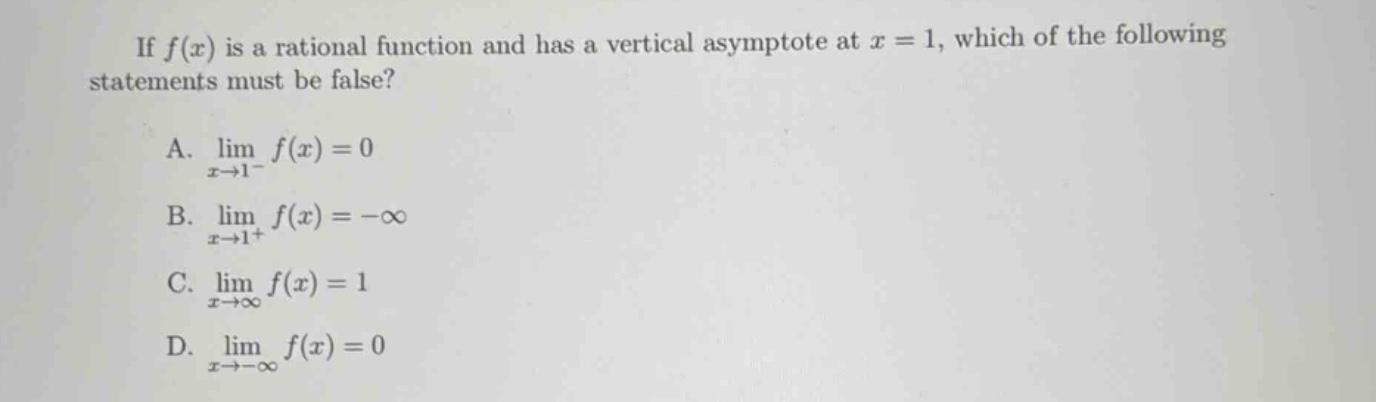
if f(x) is a rational function and has a vertical asymptote at x = 1, which of the following statements must be false? a. lim x→1− f(x)=0 b. lim x→1+ f(x)=−∞ c. lim x→∞ f(x)=1 d. lim x→−∞ f(x)=0
Answer
Explanation:
Step1: Recall vertical - asymptote property
A rational function (y = f(x)) has a vertical asymptote at (x = a) if (\lim_{x\rightarrow a^{-}}f(x)=\pm\infty) or (\lim_{x\rightarrow a^{+}}f(x)=\pm\infty). At a vertical asymptote (x = 1), the function approaches infinity or negative infinity as (x) approaches 1 from the left or right.
Step2: Analyze each option
- Option A: (\lim_{x\rightarrow1^{-}}f(x) = 0) is possible if the function has a removable - singularity or a non - infinite behavior as (x) approaches 1 from the left.
- Option B: (\lim_{x\rightarrow1^{+}}f(x)=-\infty) is consistent with the definition of a vertical asymptote.
- Option C: If (x\rightarrow1) is a vertical asymptote, (\lim_{x\rightarrow1}f(x)) cannot be a finite non - infinite value like 1. As (x) approaches a vertical asymptote, the function values go to (\pm\infty).
- Option D: (\lim_{x\rightarrow-\infty}f(x)=0) is possible for a rational function. For example, if the degree of the denominator is greater than the degree of the numerator, (\lim_{x\rightarrow\pm\infty}f(x)=0).
Answer:
C. (\lim_{x\rightarrow1}f(x)=1)