rationalize the numerator. when applicable, completely simplify your answer into a single rational…
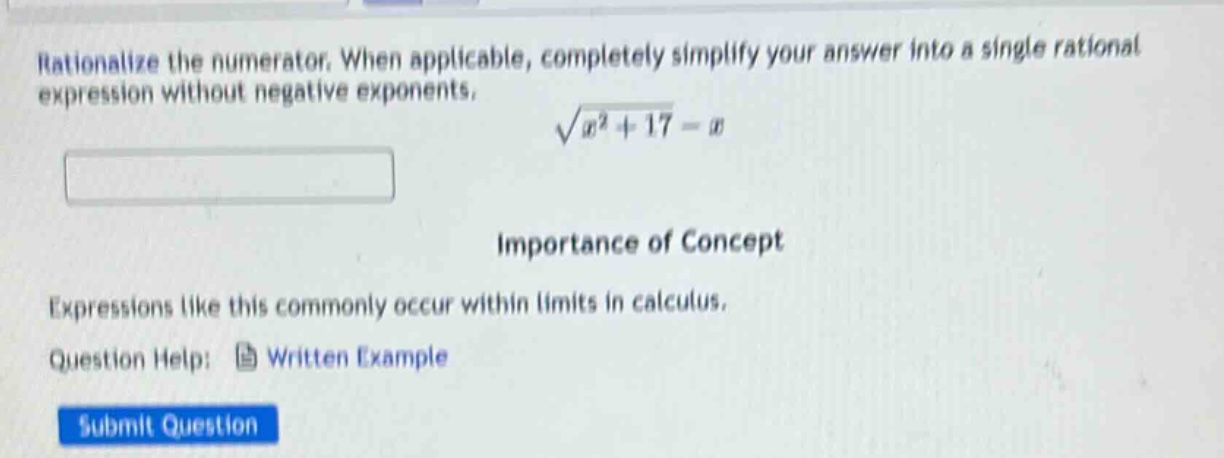
rationalize the numerator. when applicable, completely simplify your answer into a single rational expression without negative exponents. $sqrt{x^{2}+17}-x$ importance of concept expressions like this commonly occur within limits in calculus. question help: written example submit question
Answer
Explanation:
Step1: Multiply by conjugate
Multiply numerator and denominator by $\sqrt{x^{2}+17}+x$. $\frac{\sqrt{x^{2}+17}-x}{1}\times\frac{\sqrt{x^{2}+17}+x}{\sqrt{x^{2}+17}+x}$
Step2: Expand numerator
Use $(a - b)(a + b)=a^{2}-b^{2}$ on numerator. Here $a=\sqrt{x^{2}+17}$ and $b = x$. $\frac{(\sqrt{x^{2}+17})^{2}-x^{2}}{\sqrt{x^{2}+17}+x}=\frac{x^{2}+17 - x^{2}}{\sqrt{x^{2}+17}+x}$
Step3: Simplify numerator
Combine like - terms in numerator. $\frac{17}{\sqrt{x^{2}+17}+x}$
Answer:
$\frac{17}{\sqrt{x^{2}+17}+x}$