reasoning under certain conditions, the wind speed s (in knots) at an altitude of h meters above a grassy…
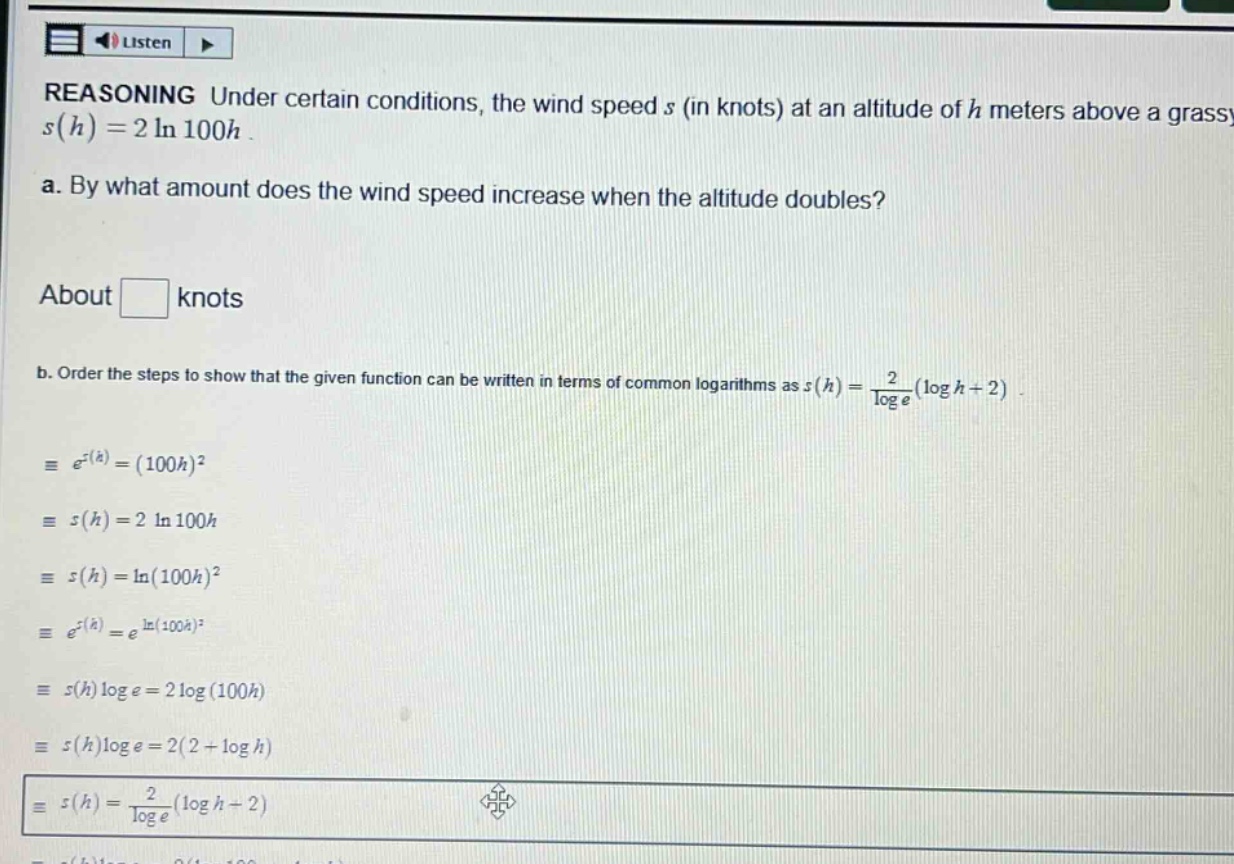
reasoning under certain conditions, the wind speed s (in knots) at an altitude of h meters above a grassy s(h)=2 ln 100h. a. by what amount does the wind speed increase when the altitude doubles? about knots b. order the steps to show that the given function can be written in terms of common logarithms as s(h)=2/log e(log h + 2). = e^s(h)=(100h)^2 = s(h)=2 ln 100h = s(h)=ln(100h)^2 = e^s(h)=e^ln(100h)^2 = s(h)log e=2 log(100h) = s(h)log e=2(2 + log h) = s(h)=2/log e(log h + 2)
Answer
Explanation:
Step1: Find wind - speed at height $h$ and $2h$
Let the wind - speed at height $h$ be $s(h)=2\ln(100h)$. The wind - speed at height $2h$ is $s(2h)=2\ln(100\times2h)=2\ln(200h)$.
Step2: Calculate the difference
We use the property of logarithms $\ln a-\ln b=\ln\frac{a}{b}$. [ \begin{align*} s(2h)-s(h)&=2\ln(200h)-2\ln(100h)\ &=2(\ln(200h)-\ln(100h))\ &=2\ln\frac{200h}{100h}\ &=2\ln2\ &\approx2\times0.693 = 1.386\approx1.39 \end{align*} ]
Step3: Order the steps for part b
- Start with $s(h)=2\ln(100h)$.
- Using the power - rule of logarithms $a\ln b=\ln(b^{a})$, we get $s(h)=\ln((100h)^{2})$.
- Exponentiate both sides: $e^{s(h)}=e^{\ln((100h)^{2})}=(100h)^{2}$.
- Use the change - of - base formula $\ln x=\frac{\log x}{\log e}$. So $s(h)\log e = 2\log(100h)$.
- Expand $\log(100h)$ using the product - rule of logarithms $\log(ab)=\log a+\log b$. We have $s(h)\log e = 2(\log100+\log h)=2(2 + \log h)$.
- Solve for $s(h)$: $s(h)=\frac{2}{\log e}(\log h + 2)$. The correct order is: $s(h)=2\ln(100h)$, $s(h)=\ln(100h)^{2}$, $e^{s(h)}=e^{\ln(100h)^{2}}$, $s(h)\log e = 2\log(100h)$, $s(h)\log e = 2(2+\log h)$, $s(h)=\frac{2}{\log e}(\log h + 2)$.
Answer:
a. About $1.39$ knots b. $s(h)=2\ln(100h)$, $s(h)=\ln(100h)^{2}$, $e^{s(h)}=e^{\ln(100h)^{2}}$, $s(h)\log e = 2\log(100h)$, $s(h)\log e = 2(2+\log h)$, $s(h)=\frac{2}{\log e}(\log h + 2)$