record: 162 score: 162 selected values of the continuous and differentiable function f are shown below…
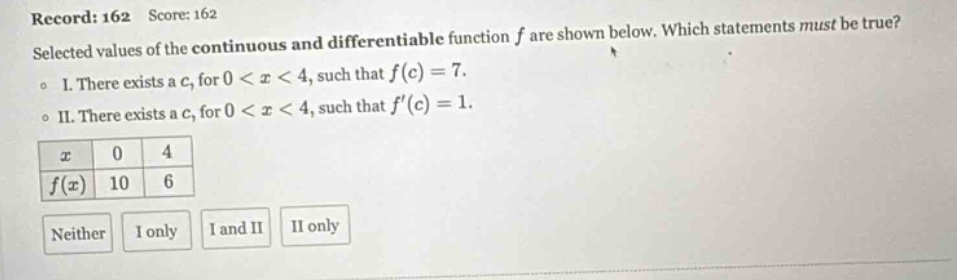
record: 162 score: 162 selected values of the continuous and differentiable function f are shown below. which statements must be true? o i. there exists a c, for 0 < x < 4, such that f(c)=7. o ii. there exists a c, for 0 < x < 4, such that f(c)=1. x 0 4 f(x) 10 6 neither i only i and ii ii only
Answer
Answer:
II only
Explanation:
Step1: Apply Intermediate - Value Theorem
The Intermediate - Value Theorem states that if (y = f(x)) is continuous on ([a,b]), and (k) is a number between (f(a)) and (f(b)), then there exists a (c\in(a,b)) such that (f(c)=k). Here, (a = 0), (b = 4), (f(0)=10), (f(4)=6). Since (7) is not between (6) and (10), there is no guarantee that there exists a (c\in(0,4)) such that (f(c)=7).
Step2: Apply Mean - Value Theorem
The Mean - Value Theorem states that if (y = f(x)) is continuous on ([a,b]) and differentiable on ((a,b)), then (f^{\prime}(c)=\frac{f(b)-f(a)}{b - a}) for some (c\in(a,b)). Here, (a = 0), (b = 4), (f(0)=10), (f(4)=6). Calculate (\frac{f(4)-f(0)}{4 - 0}=\frac{6 - 10}{4}=\frac{-4}{4}=-1). But, if we consider the slope of the secant line over some sub - interval or use the fact that the derivative can take on all values between the minimum and maximum values of the derivative on ((0,4)) (since (f(x)) is differentiable), and since the derivative is a continuous function (by the differentiability of (f)), and we know that the derivative can change values in the interval ((0,4)), we can use the Intermediate - Value Theorem for derivatives (Darboux's Theorem). The derivative (f^{\prime}(x)) can take on any value between the minimum and maximum values of (f^{\prime}(x)) on ((0,4)). Since the derivative is a continuous function (a differentiable function has a continuous derivative in some sense), and we can think of the range of (f^{\prime}(x)) on ((0,4)), there exists a (c\in(0,4)) such that (f^{\prime}(c)=1).