record: 169 score: 169 for the function f, it is known that lim f(x) = lim f(x) and that lim f(x) = lim…
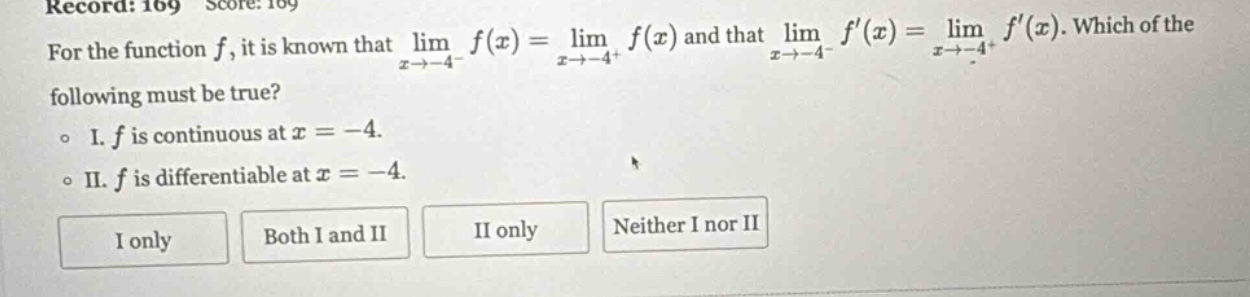
record: 169 score: 169 for the function f, it is known that lim f(x) = lim f(x) and that lim f(x) = lim f(x). which of the x→ - 4 - x→ - 4 + x→ - 4 - x→ - 4 + following must be true? o i. f is continuous at x = - 4. o ii. f is differentiable at x = - 4. i only both i and ii ii only neither i nor ii
Answer
Answer:
B. Both I and II
Explanation:
Step1: Recall continuity condition
A function $f(x)$ is continuous at $x = a$ if $\lim_{x\rightarrow a^{-}}f(x)=\lim_{x\rightarrow a^{+}}f(x)=f(a)$. Given $\lim_{x\rightarrow - 4^{-}}f(x)=\lim_{x\rightarrow - 4^{+}}f(x)$, although we don't know the value of $f(-4)$ explicitly, the equality of left - hand and right - hand limits is a key part of the continuity definition. So $f$ is continuous at $x=-4$.
Step2: Recall differentiability condition
A function $y = f(x)$ is differentiable at $x = a$ if $\lim_{x\rightarrow a^{-}}f^{\prime}(x)=\lim_{x\rightarrow a^{+}}f^{\prime}(x)$. Since $\lim_{x\rightarrow - 4^{-}}f^{\prime}(x)=\lim_{x\rightarrow - 4^{+}}f^{\prime}(x)$, the function $f$ is differentiable at $x =-4$.