record: 25 score: 25 let g(x)=∫₀ˣ f(t)dt, where the graph of f is shown below. on what interval(s) is g both…
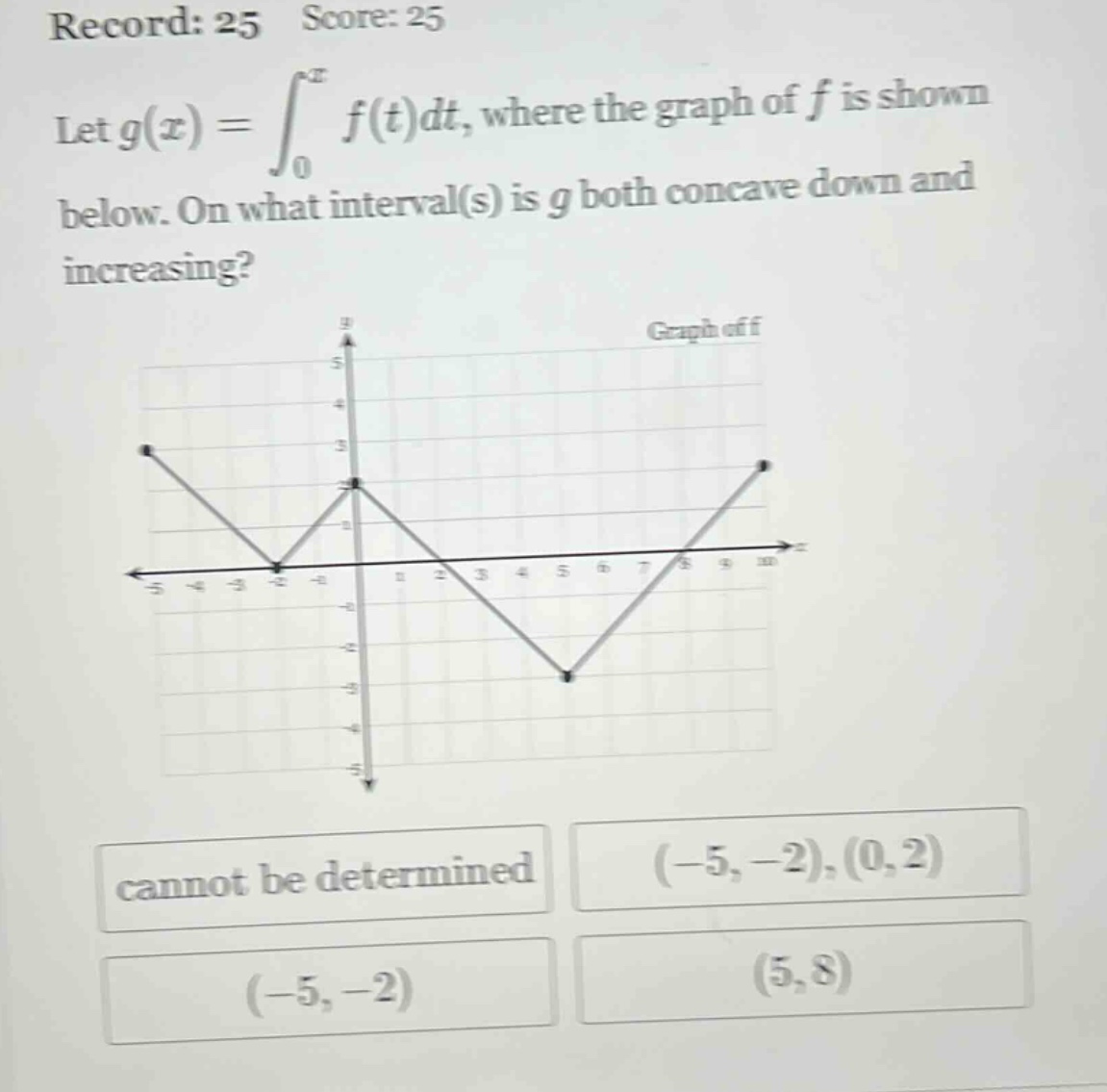
record: 25 score: 25 let g(x)=∫₀ˣ f(t)dt, where the graph of f is shown below. on what interval(s) is g both concave down and increasing? cannot be determined (-5, -2) (-5, -2), (0, 2) (5, 8)
Answer
Explanation:
Step1: Recall fundamental theorem of calculus
By the fundamental - theorem of calculus, $g^\prime(x)=f(x)$ and $g^{\prime\prime}(x)=f^\prime(x)$. $g$ is increasing when $g^\prime(x)=f(x)>0$ and $g$ is concave down when $g^{\prime\prime}(x)=f^\prime(x)<0$.
Step2: Analyze the sign of $f(x)$ and $f^\prime(x)$ from the graph
- Sign of $f(x)$:
- $f(x)>0$ when the graph of $y = f(x)$ is above the $x$ - axis. From the graph, $f(x)>0$ on the intervals $(-5,-2)$ and $(0,2)$.
- Sign of $f^\prime(x)$:
- $f^\prime(x)<0$ when the function $y = f(x)$ is decreasing. From the graph, $f(x)$ is decreasing on the intervals $(-5,-2)$ and $(5,8)$.
- Find the intersection:
- The intersection of the intervals where $f(x)>0$ and $f^\prime(x)<0$ is the interval $(-5,-2)$.
Answer:
$(-5,-2)$