record: 43 score: 43 selected values of the function f are shown below. which statements must be true? o i…
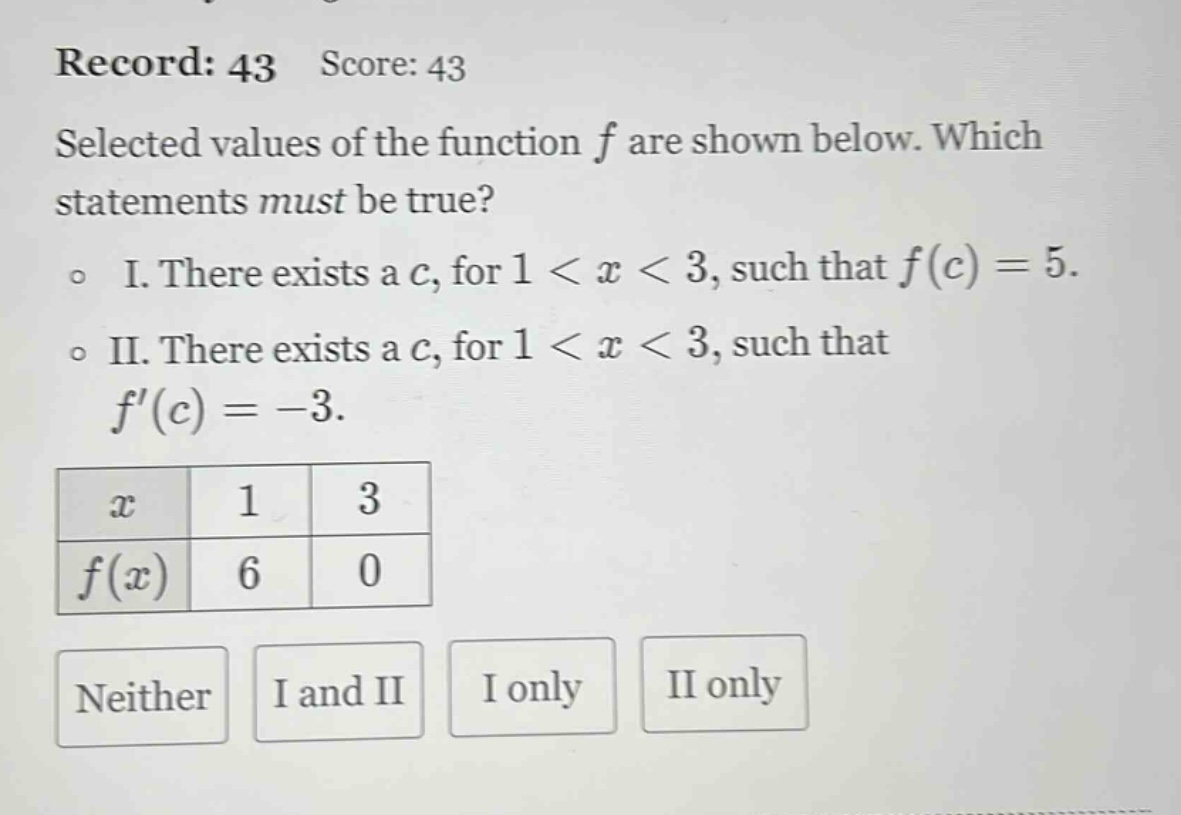
record: 43 score: 43 selected values of the function f are shown below. which statements must be true? o i. there exists a c, for 1 < x < 3, such that f(c)=5. o ii. there exists a c, for 1 < x < 3, such that f(c)= - 3. x 1 3 f(x) 6 0 neither i and ii i only ii only
Answer
Explanation:
Step1: Apply Intermediate - Value Theorem
The Intermediate - Value Theorem states that if a function (y = f(x)) is continuous on the closed interval ([a,b]), and (k) is a number between (f(a)) and (f(b)), then there exists at least one number (c) in the open interval ((a,b)) such that (f(c)=k). Here, (a = 1), (b = 3), (f(1)=6), (f(3)=0), and (k = 5). Since (0<5<6) and if (f(x)) is continuous on ([1,3]), there exists a (c\in(1,3)) such that (f(c)=5).
Step2: Apply Mean - Value Theorem
The Mean - Value Theorem states that if (y = f(x)) is continuous on the closed interval ([a,b]) and differentiable on the open interval ((a,b)), then there exists at least one number (c\in(a,b)) such that (f^{\prime}(c)=\frac{f(b)-f(a)}{b - a}). Here, (a = 1), (b = 3), (f(1)=6), (f(3)=0), so (\frac{f(3)-f(1)}{3 - 1}=\frac{0 - 6}{2}=-3). So, if (f(x)) is continuous on ([1,3]) and differentiable on ((1,3)), there exists a (c\in(1,3)) such that (f^{\prime}(c)=-3).
Answer:
I and II