a rectangle is inscribed with its base on the x - axis and its upper corners on the parabola y = 2 - x²…
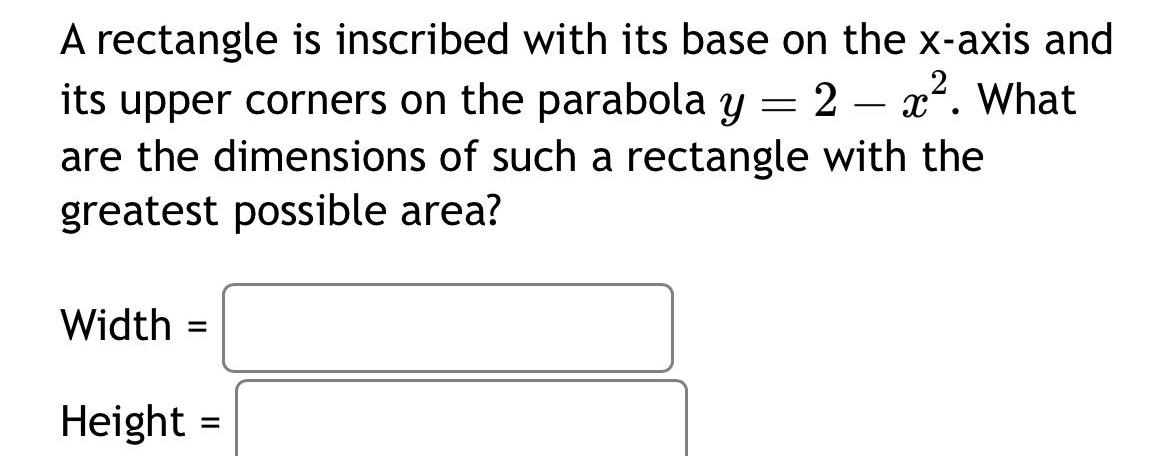
a rectangle is inscribed with its base on the x - axis and its upper corners on the parabola y = 2 - x². what are the dimensions of such a rectangle with the greatest possible area? width = height =
Answer
Explanation:
Step1: Define variables
Let the x - coordinate of the right - hand lower vertex of the rectangle be (x). Then the width of the rectangle (w = 2x) and the height (h=y = 2 - x^{2}), where (x>0). The area of the rectangle (A=w\times h=(2x)(2 - x^{2})=4x-2x^{3}).
Step2: Find the derivative
Differentiate (A(x)=4x - 2x^{3}) with respect to (x). Using the power rule ((x^n)^\prime=nx^{n - 1}), we have (A^\prime(x)=\frac{d}{dx}(4x-2x^{3})=4 - 6x^{2}).
Step3: Find critical points
Set (A^\prime(x)=0), so (4 - 6x^{2}=0). Rearranging gives (6x^{2}=4), then (x^{2}=\frac{2}{3}), and (x=\sqrt{\frac{2}{3}}) (we take the positive value since (x) represents a distance).
Step4: Find the second - derivative
Differentiate (A^\prime(x)=4 - 6x^{2}) to get the second - derivative (A^{\prime\prime}(x)=\frac{d}{dx}(4 - 6x^{2})=-12x). When (x = \sqrt{\frac{2}{3}}), (A^{\prime\prime}(\sqrt{\frac{2}{3}})=-12\sqrt{\frac{2}{3}}<0), which means the area is maximized at (x=\sqrt{\frac{2}{3}}).
Step5: Calculate width and height
The width (w = 2x=2\sqrt{\frac{2}{3}}=\frac{2\sqrt{6}}{3}). The height (h=2 - x^{2}=2-\frac{2}{3}=\frac{4}{3}).
Answer:
Width = (\frac{2\sqrt{6}}{3}), Height = (\frac{4}{3})