refer to the graph of the function and complete the statement. part 1 of 10 (a) as x→−∞,f(x)→2. part 2 of 10…
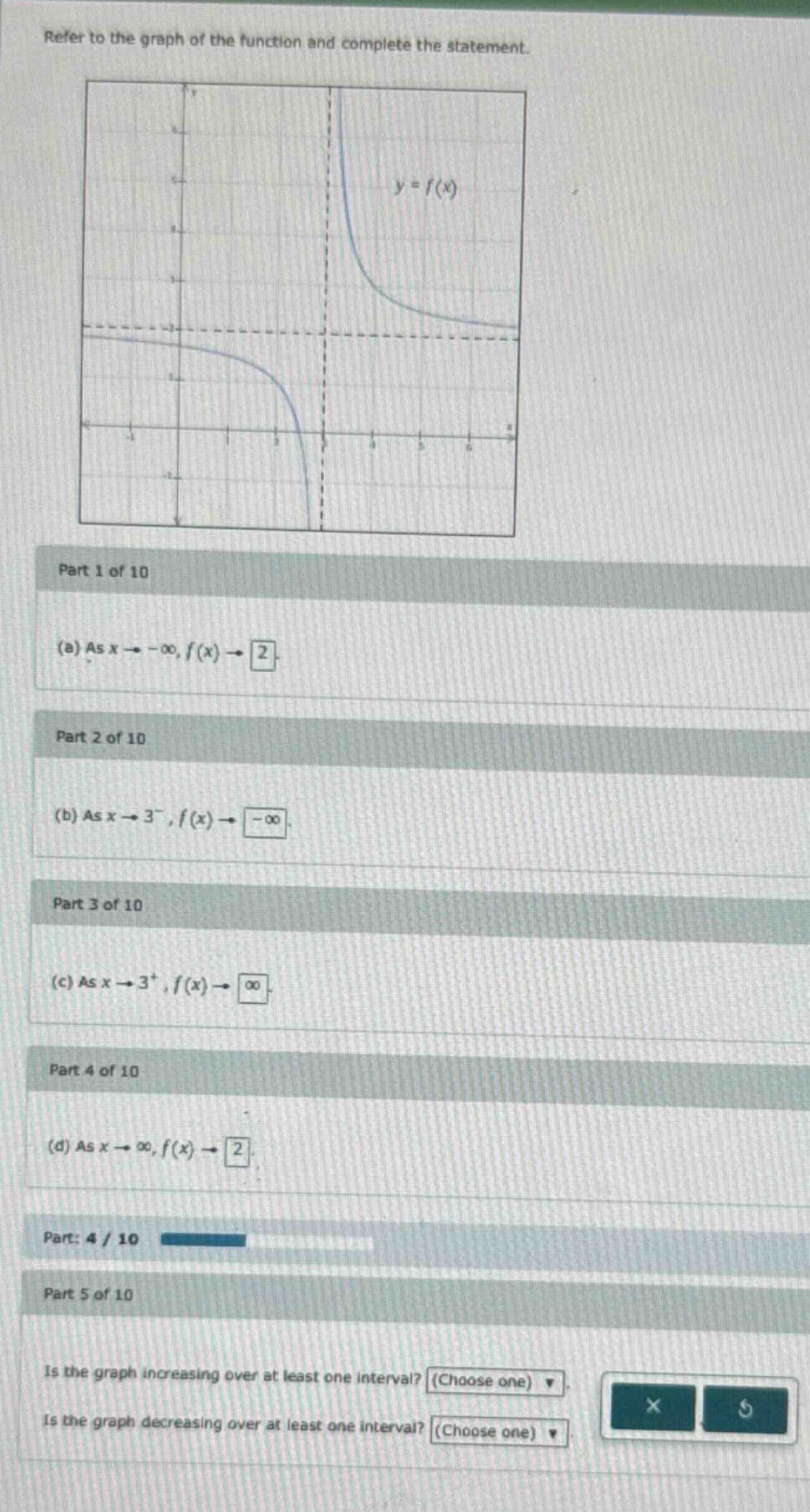
refer to the graph of the function and complete the statement. part 1 of 10 (a) as x→−∞,f(x)→2. part 2 of 10 (b) as x→3−,f(x)→−∞. part 3 of 10 (c) as x→3+,f(x)→∞. part 4 of 10 (d) as x→∞,f(x)→2. part: 4 / 10 part 5 of 10 is the graph increasing over at least one interval? (choose one) is the graph decreasing over at least one interval? (choose one)
Answer
Explanation:
Step1: Analyze the graph for increasing intervals
By observing the graph, we can see that there are no intervals where the function is increasing. As we move from left - to - right, the function either decreases or remains constant.
Step2: Analyze the graph for decreasing intervals
The function is decreasing for (x>3) and also for (x < 3) in parts of its domain.
Answer:
Is the graph increasing over at least one interval? No Is the graph decreasing over at least one interval? Yes