8. a referee moves along a straight path on the side of an athletic field. the velocity of the referee is…
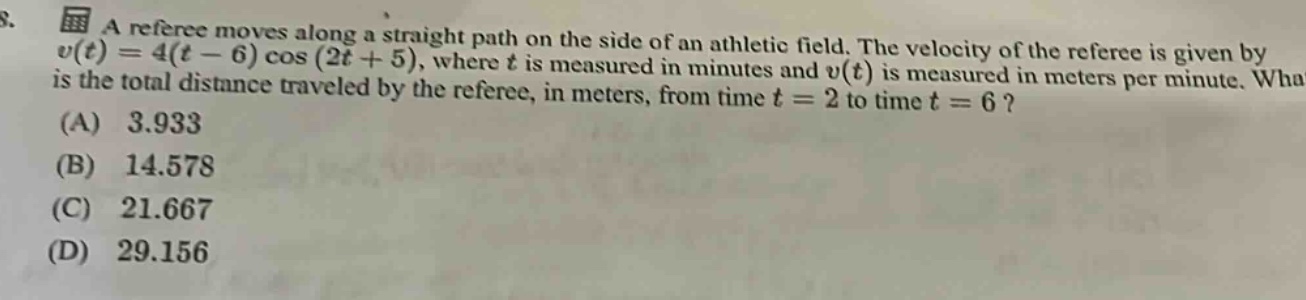
8. a referee moves along a straight path on the side of an athletic field. the velocity of the referee is given by v(t)=4(t - 6)cos(2t + 5), where t is measured in minutes and v(t) is measured in meters per minute. what is the total distance traveled by the referee, in meters, from time t = 2 to time t = 6? (a) 3.933 (b) 14.578 (c) 21.667 (d) 29.156
Answer
Explanation:
Step1: Recall distance - velocity relation
The total distance $d$ traveled by an object with velocity $v(t)$ from $t = a$ to $t = b$ is given by $d=\int_{a}^{b}|v(t)|dt$. Here, $a = 2$, $b = 6$ and $v(t)=4(t - 6)\cos(2t + 5)$.
Step2: Use a calculator for definite - integral
We need to calculate $\int_{2}^{6}|4(t - 6)\cos(2t+5)|dt$. Using a graphing calculator or a software like Wolfram - Alpha to evaluate the definite integral of the absolute - value of the function $y = 4(t - 6)\cos(2t + 5)$ from $t = 2$ to $t = 6$.
Answer:
B. 14.578