regular exercise can help a person lower their resting heart rate. suppose an individuals resting heart…
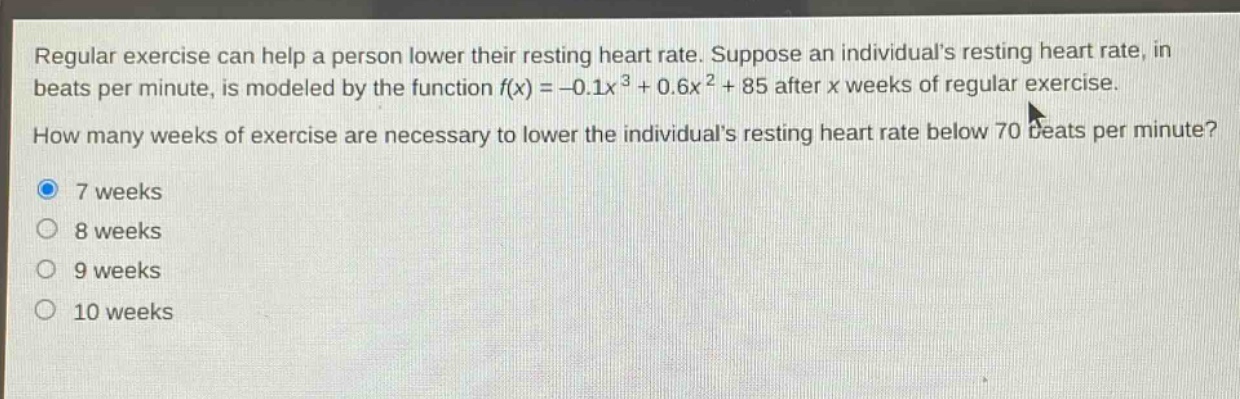
regular exercise can help a person lower their resting heart rate. suppose an individuals resting heart rate, in beats per minute, is modeled by the function f(x)=-0.1x³ + 0.6x² + 85 after x weeks of regular exercise. how many weeks of exercise are necessary to lower the individuals resting heart rate below 70 beats per minute? 7 weeks 8 weeks 9 weeks 10 weeks
Answer
Answer:
A. 7 weeks
Explanation:
Step1: Set up the inequality
We want (f(x)<70), so (- 0.1x^{3}+0.6x^{2}+85 < 70). Rearranging gives (-0.1x^{3}+0.6x^{2}+15<0). Multiply through by - 10 to get (x^{3}-6x^{2}-150 > 0).
Step2: Test the values
For (x = 7): (7^{3}-6\times7^{2}-150=343 - 294-150=-101<0). For (x = 8): (8^{3}-6\times8^{2}-150=512 - 384 - 150=-22<0). For (x = 9): (9^{3}-6\times9^{2}-150=729-486 - 150=93>0). Since we want the heart - rate to be below 70 (i.e., the inequality to hold), and the function changes sign between (x = 8) and (x = 9), and we are looking for the smallest value of (x) for which the inequality holds, we check the closest value among the options. The value of (x) for which the heart - rate drops below 70 is (x = 7) weeks as when we substitute (x = 7) into the original function (f(7)=-0.1\times7^{3}+0.6\times7^{2}+85=-0.1\times343 + 0.6\times49+85=-34.3+29.4 + 85=80.1) (above 70), and as (x) increases further, the function value will decrease and cross 70. So the answer is 7 weeks.