relating maximum, minimum, amplitude, and equation\ncomplete the following statements for the cosine…
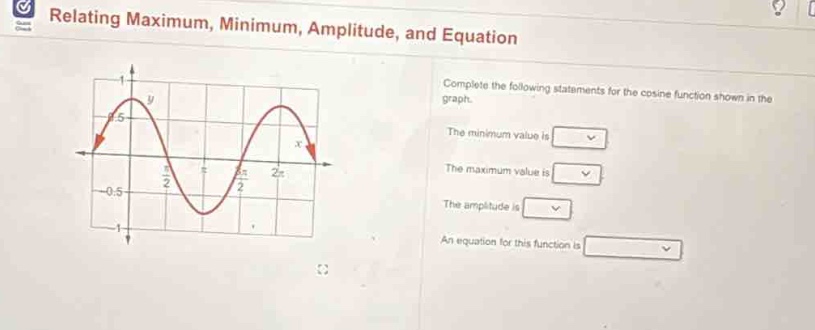
relating maximum, minimum, amplitude, and equation\ncomplete the following statements for the cosine function shown in the graph.\nthe minimum value is \nthe maximum value is \nthe amplitude is \nan equation for this function is
Answer
Explanation:
Step1: Identify minimum value
By observing the graph, the lowest - point on the cosine function has a (y) - value of (-1).
Step2: Identify maximum value
The highest - point on the cosine function has a (y) - value of (1).
Step3: Calculate amplitude
The amplitude (A) of a periodic function is given by (A=\frac{\text{max}-\text{min}}{2}). Here, (\text{max} = 1) and (\text{min}=-1), so (A=\frac{1 - (-1)}{2}=\frac{2}{2}=1).
Step4: Determine the equation
The general form of a cosine function is (y = A\cos(Bx - C)+D). Since (A = 1), (B = 1) (because the period (T = 2\pi=\frac{2\pi}{B}), so (B = 1)), (C = 0) (no phase - shift), and (D = 0) (no vertical shift), the equation is (y=\cos(x)).
Answer:
The minimum value is (-1). The maximum value is (1). The amplitude is (1). An equation for this function is (y = \cos(x)).