7. g(x) = (x - 1)/(x - 2)\na) relative maximum_\nb) relative minimum_\nc) increasing_\nd) decreasing_\ne)…
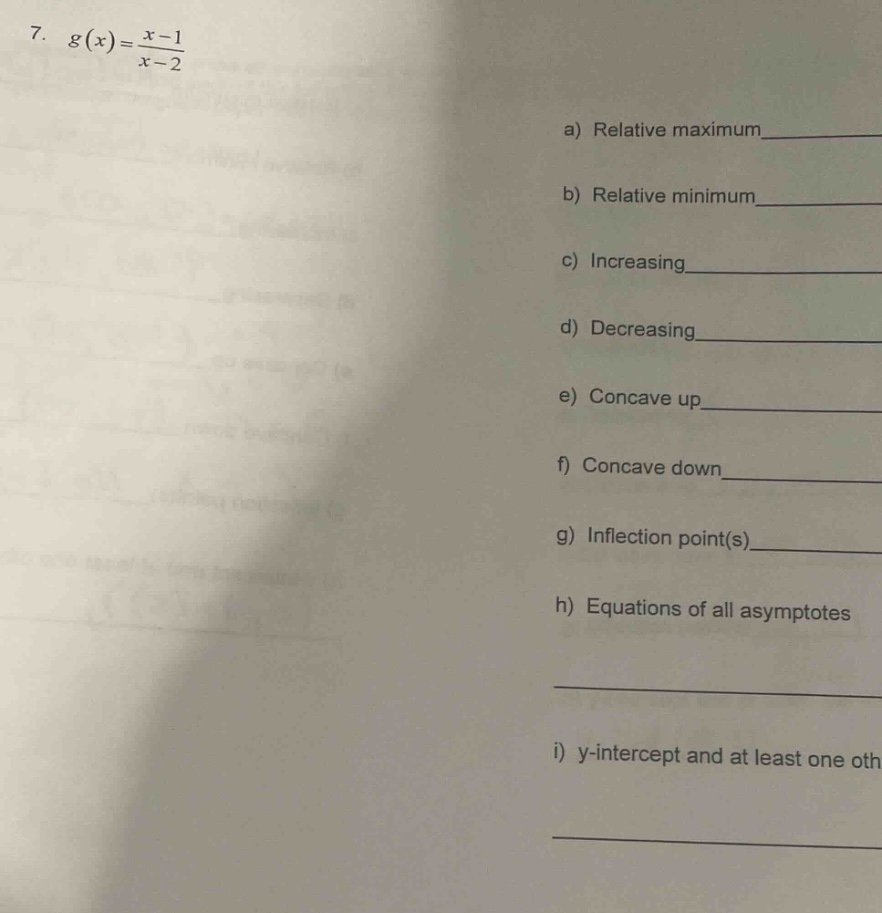
7. g(x) = (x - 1)/(x - 2)\na) relative maximum_\nb) relative minimum_\nc) increasing_\nd) decreasing_\ne) concave up_\nf) concave down_\ng) inflection point(s)_\nh) equations of all asymptotes_\ni) y - intercept and at least one oth_
Answer
Explanation:
Step1: Rewrite the function
Rewrite $g(x)=\frac{x - 1}{x - 2}$ as $g(x)=\frac{x-2 + 1}{x - 2}=1+\frac{1}{x - 2}$.
Step2: Find the first - derivative
Using the quotient rule, if $y=\frac{u}{v}$, then $y^\prime=\frac{u^\prime v - uv^\prime}{v^{2}}$. Here, $u=x - 1$, $u^\prime=1$, $v=x - 2$, $v^\prime=1$. So $g^\prime(x)=\frac{1\times(x - 2)-(x - 1)\times1}{(x - 2)^{2}}=\frac{x-2-x + 1}{(x - 2)^{2}}=-\frac{1}{(x - 2)^{2}}$. Since $g^\prime(x)\lt0$ for all $x\neq2$, the function has no relative maximum or minimum. The function is decreasing on $(-\infty,2)\cup(2,\infty)$ and has no increasing intervals.
Step3: Find the second - derivative
Using the quotient rule on $g^\prime(x)=-\frac{1}{(x - 2)^{2}}=-(x - 2)^{-2}$. Let $u=-1$, $u^\prime = 0$, $v=(x - 2)^{2}$, $v^\prime=2(x - 2)$. Then $g^{\prime\prime}(x)=\frac{0\times(x - 2)^{2}-(-1)\times2(x - 2)}{(x - 2)^{4}}=\frac{2}{(x - 2)^{3}}$.
Step4: Analyze concavity
Set $g^{\prime\prime}(x)=0$, but $\frac{2}{(x - 2)^{3}}\neq0$ for any real $x$. When $x\gt2$, $g^{\prime\prime}(x)\gt0$, so the function is concave up on $(2,\infty)$. When $x\lt2$, $g^{\prime\prime}(x)\lt0$, so the function is concave down on $(-\infty,2)$. There are no inflection points since $g^{\prime\prime}(x)$ is never zero.
Step5: Find asymptotes
Vertical asymptote: Set the denominator of the original function equal to zero. $x-2 = 0$, so $x = 2$ is the vertical asymptote. Horizontal asymptote: $\lim_{x\rightarrow\pm\infty}g(x)=\lim_{x\rightarrow\pm\infty}(1+\frac{1}{x - 2})=1$, so $y = 1$ is the horizontal asymptote.
Step6: Find the y - intercept
Set $x = 0$, then $g(0)=\frac{0 - 1}{0 - 2}=\frac{1}{2}$. Let $x=3$, then $g(3)=\frac{3 - 1}{3 - 2}=2$.
Answer:
a) None b) None c) None d) $(-\infty,2)\cup(2,\infty)$ e) $(2,\infty)$ f) $(-\infty,2)$ g) None h) Vertical: $x = 2$, Horizontal: $y = 1$ i) y - intercept: $(0,\frac{1}{2})$, another point: $(3,2)$