8. f(x)=(x² + 3)/x\na) relative maximum\n\nb) relative minimum\n\nc) increasing\n\nd) decreasing\n\ne)…
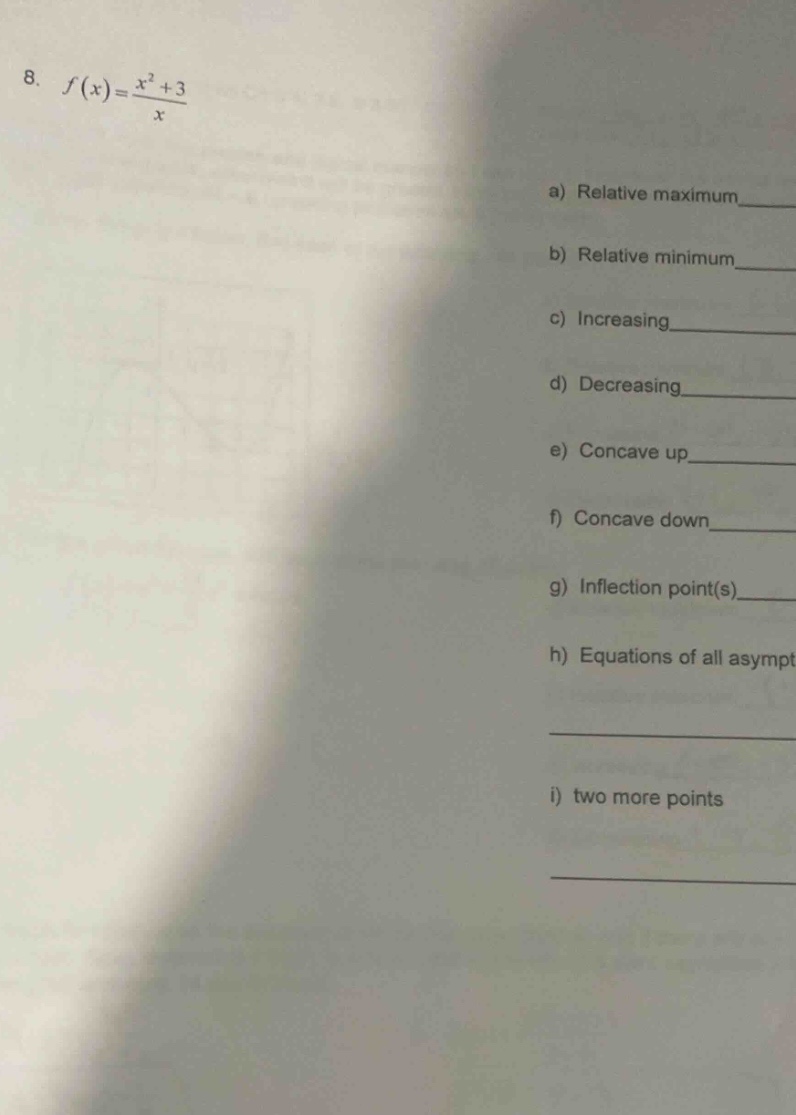
8. f(x)=(x² + 3)/x\na) relative maximum\n\nb) relative minimum\n\nc) increasing\n\nd) decreasing\n\ne) concave up\n\nf) concave down\n\ng) inflection point(s)\n\nh) equations of all asymptot\n\ni) two more points
Answer
Explanation:
Step1: Rewrite the function
Rewrite $f(x)=\frac{x^{2}+3}{x}$ as $f(x)=x + \frac{3}{x}=x+3x^{-1}$, $x\neq0$.
Step2: Find the first - derivative
Using the power rule $(x^n)'=nx^{n - 1}$, we have $f'(x)=1-3x^{-2}=1-\frac{3}{x^{2}}=\frac{x^{2}-3}{x^{2}}$.
Step3: Find critical points
Set $f'(x) = 0$, then $\frac{x^{2}-3}{x^{2}}=0$, which gives $x^{2}-3 = 0$ and $x=\pm\sqrt{3}$.
Step4: Determine increasing and decreasing intervals
Test intervals: For $x\in(-\infty,-\sqrt{3})$, let $x=-2$, $f'(-2)=1-\frac{3}{4}=\frac{1}{4}>0$, so $f(x)$ is increasing on $(-\infty,-\sqrt{3})$. For $x\in(-\sqrt{3},0)$, let $x = - 1$, $f'(-1)=1 - 3=-2<0$, so $f(x)$ is decreasing on $(-\sqrt{3},0)$. For $x\in(0,\sqrt{3})$, let $x = 1$, $f'(1)=1 - 3=-2<0$, so $f(x)$ is decreasing on $(0,\sqrt{3})$. For $x\in(\sqrt{3},\infty)$, let $x = 2$, $f'(2)=1-\frac{3}{4}=\frac{1}{4}>0$, so $f(x)$ is increasing on $(\sqrt{3},\infty)$.
Step5: Find relative extrema
Since $f(x)$ changes from increasing to decreasing at $x =-\sqrt{3}$, $f(-\sqrt{3})=-\sqrt{3}-\sqrt{3}=-2\sqrt{3}$ is a relative maximum. Since $f(x)$ changes from decreasing to increasing at $x=\sqrt{3}$, $f(\sqrt{3})=\sqrt{3}+\sqrt{3}=2\sqrt{3}$ is a relative minimum.
Step6: Find the second - derivative
$f'(x)=1 - 3x^{-2}$, then $f''(x)=6x^{-3}=\frac{6}{x^{3}}$.
Step7: Determine concavity and inflection points
Set $f''(x)=0$, $\frac{6}{x^{3}} = 0$ has no solution. But $f''(x)$ is undefined at $x = 0$. For $x\in(-\infty,0)$, $f''(x)<0$, so $f(x)$ is concave down on $(-\infty,0)$. For $x\in(0,\infty)$, $f''(x)>0$, so $f(x)$ is concave up on $(0,\infty)$. There is no inflection point since $x = 0$ is not in the domain of $f(x)$.
Step8: Find asymptotes
Vertical asymptote: Since the function is undefined at $x = 0$, $x = 0$ is a vertical asymptote. For horizontal asymptote, $\lim_{x\rightarrow\pm\infty}\frac{x^{2}+3}{x}=\lim_{x\rightarrow\pm\infty}(x+\frac{3}{x})=\pm\infty$, no horizontal asymptote. For slant asymptote, since $\frac{x^{2}+3}{x}=x+\frac{3}{x}$, $y = x$ is a slant asymptote.
Step9: Find two more points
Let $x = 1$, $f(1)=1 + 3=4$. Let $x=-1$, $f(-1)=-1-3=-4$.
Answer:
a) $-2\sqrt{3}$ b) $2\sqrt{3}$ c) $(-\infty,-\sqrt{3})\cup(\sqrt{3},\infty)$ d) $(-\sqrt{3},0)\cup(0,\sqrt{3})$ e) $(0,\infty)$ f) $(-\infty,0)$ g) None h) $x = 0$ (vertical), $y=x$ (slant) i) $(1,4),(-1,-4)$