what are the removable discontinuities of the following function?\nf(x)=\frac{x^{2}-36}{x^{3}-36x}\nx =…
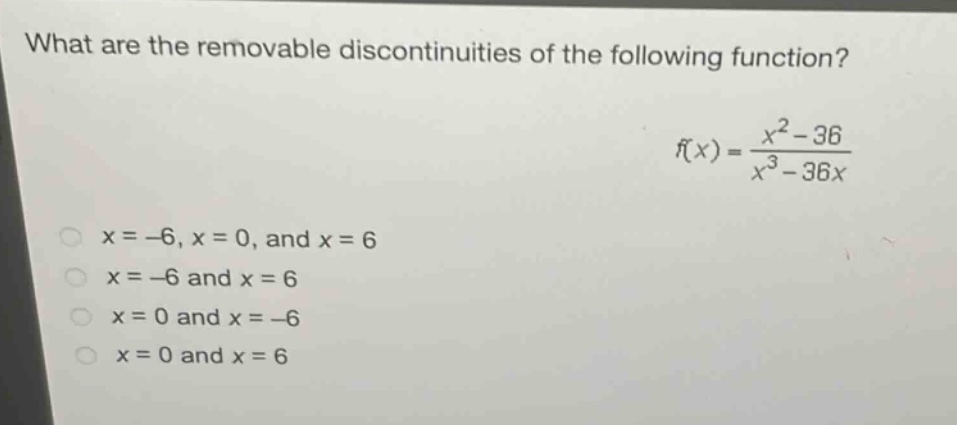
what are the removable discontinuities of the following function?\nf(x)=\frac{x^{2}-36}{x^{3}-36x}\nx = - 6,x = 0,\text{ and }x = 6\nx=-6\text{ and }x = 6\nx = 0\text{ and }x=-6\nx = 0\text{ and }x = 6
Answer
Explanation:
Step1: Factor the numerator and denominator
The numerator $x^{2}-36=(x + 6)(x - 6)$ by the difference - of - squares formula $a^{2}-b^{2}=(a + b)(a - b)$. The denominator $x^{3}-36x=x(x^{2}-36)=x(x + 6)(x - 6)$. So, $f(x)=\frac{(x + 6)(x - 6)}{x(x + 6)(x - 6)}$.
Step2: Simplify the function
Cancel out the common factors $(x + 6)$ and $(x - 6)$ (for $x\neq - 6$ and $x\neq6$). The simplified function is $f(x)=\frac{1}{x}$ for $x\neq - 6,x\neq0,x\neq6$.
Step3: Identify removable discontinuities
Removable discontinuities occur at the values of $x$ that make the original function undefined but can be removed by simplification. The values $x=-6$ and $x = 6$ make the original function undefined, but after canceling out the common factors, the function is well - behaved at these points in a sense. The discontinuity at $x = 0$ is a non - removable vertical asymptote since it makes the simplified function $\frac{1}{x}$ undefined.
Answer:
B. $x=-6$ and $x = 6$