3. researchers have found a creature from an alien planet. its body temperature is varying sinusoidally with…
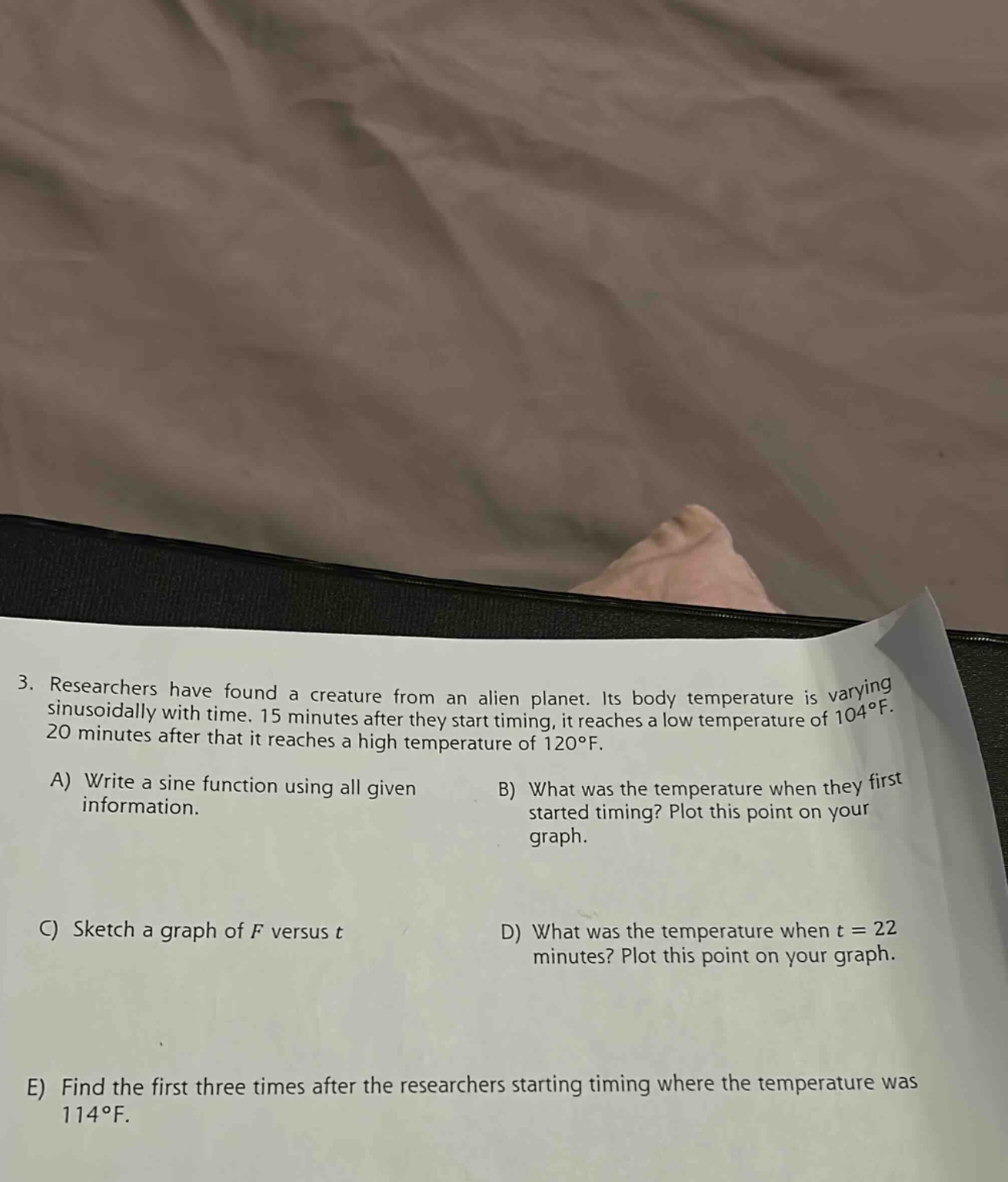
3. researchers have found a creature from an alien planet. its body temperature is varying sinusoidally with time. 15 minutes after they start timing, it reaches a low temperature of 104°f. 20 minutes after that it reaches a high temperature of 120°f. a) write a sine function using all given information. b) what was the temperature when they first started timing? plot this point on your graph. c) sketch a graph of f versus t d) what was the temperature when t = 22 minutes? plot this point on your graph. e) find the first three times after the researchers starting timing where the temperature was 114°f.
Answer
Explanation:
Step1: Determine amplitude, period and vertical shift
The amplitude $A=\frac{120 - 104}{2}=8$. The period $T = 2\times20=40$ (since time from low - to high is half of the period), so $\omega=\frac{2\pi}{T}=\frac{2\pi}{40}=\frac{\pi}{20}$. The vertical shift $D=\frac{120 + 104}{2}=112$. The low - point occurs at $t = 15$. For a sine function $y = A\sin(\omega(t - h))+D$, when $\sin(\omega(t - h))=- 1$ at $t = 15$. So $-1=\sin(\frac{\pi}{20}(15 - h))$, which gives $\frac{\pi}{20}(15 - h)=\frac{3\pi}{2}+2k\pi,k\in\mathbb{Z}$. Solving for $h$: [ \begin{align*} \frac{\pi}{20}(15 - h)&=\frac{3\pi}{2}\ 15 - h&=30\ h&=- 15 \end{align*} ] The sine function is $F(t)=8\sin(\frac{\pi}{20}(t + 15))+112$.
Step2: Find initial temperature
When $t = 0$, $F(0)=8\sin(\frac{\pi}{20}(0 + 15))+112=8\sin(\frac{3\pi}{4})+112=8\times\frac{\sqrt{2}}{2}+112=4\sqrt{2}+112\approx117.66^{\circ}F$.
Step3: Sketch the graph
The general form of the sine - wave is $y = A\sin(\omega(t - h))+D$. Mark the key points: the low - point at $(15,104)$, high - point at $(35,120)$, mid - line at $y = 112$. The period is $T = 40$, so the graph repeats every 40 minutes.
Step4: Find temperature at $t = 22$
$F(22)=8\sin(\frac{\pi}{20}(22 + 15))+112=8\sin(\frac{37\pi}{20})+112$. Since $\sin(\frac{37\pi}{20})=\sin(2\pi-\frac{3\pi}{20})=-\sin(\frac{3\pi}{20})\approx - 0.4756$, then $F(22)=8\times(-0.4756)+112=-3.8048 + 112 = 108.1952^{\circ}F$.
Step5: Find times when $F(t)=114$
Set $114=8\sin(\frac{\pi}{20}(t + 15))+112$. Then $2 = 8\sin(\frac{\pi}{20}(t + 15))$, so $\sin(\frac{\pi}{20}(t + 15))=\frac{1}{4}$. $\frac{\pi}{20}(t + 15)=\sin^{-1}(\frac{1}{4})+2k\pi$ or $\frac{\pi}{20}(t + 15)=\pi-\sin^{-1}(\frac{1}{4})+2k\pi$. For $k = 0$:
- $\frac{\pi}{20}(t + 15)=\sin^{-1}(\frac{1}{4})$, $t=\frac{20\sin^{-1}(\frac{1}{4})}{\pi}-15\approx\frac{20\times0.2527}{\pi}-15\approx1.61 - 15=-13.39$ (rejected as $t\geq0$).
- $\frac{\pi}{20}(t + 15)=\pi-\sin^{-1}(\frac{1}{4})$, $t=\frac{20(\pi-\sin^{-1}(\frac{1}{4}))}{\pi}-15\approx\frac{20\times(3.14 - 0.2527)}{\pi}-15=\frac{20\times2.8873}{\pi}-15\approx18.37 - 15 = 3.37$. For $k = 1$:
- $\frac{\pi}{20}(t + 15)=\sin^{-1}(\frac{1}{4})+2\pi$, $t=\frac{20(\sin^{-1}(\frac{1}{4})+2\pi)}{\pi}-15\approx\frac{20\times(0.2527+6.2832)}{\pi}-15=\frac{20\times6.5359}{\pi}-15\approx41.63 - 15 = 26.63$. For $k = 1$ in the second case:
- $\frac{\pi}{20}(t + 15)=\pi-\sin^{-1}(\frac{1}{4})+2\pi$, $t=\frac{20(3\pi-\sin^{-1}(\frac{1}{4}))}{\pi}-15\approx\frac{20\times(9.42 - 0.2527)}{\pi}-15=\frac{20\times9.1673}{\pi}-15\approx58.37 - 15 = 43.37$.
The first three non - negative times are approximately $t_1\approx3.37$ minutes, $t_2\approx26.63$ minutes, $t_3\approx43.37$ minutes.
Answer:
A) $F(t)=8\sin(\frac{\pi}{20}(t + 15))+112$ B) Approximately $117.66^{\circ}F$ C) Sketch with low - point at $(15,104)$, high - point at $(35,120)$, mid - line $y = 112$ and period $T = 40$ D) Approximately $108.20^{\circ}F$ E) Approximately $3.37$ minutes, $26.63$ minutes, $43.37$ minutes