what restriction should be applied to y = tanx for y = arctanx to be defined?\nrestrict the range to…
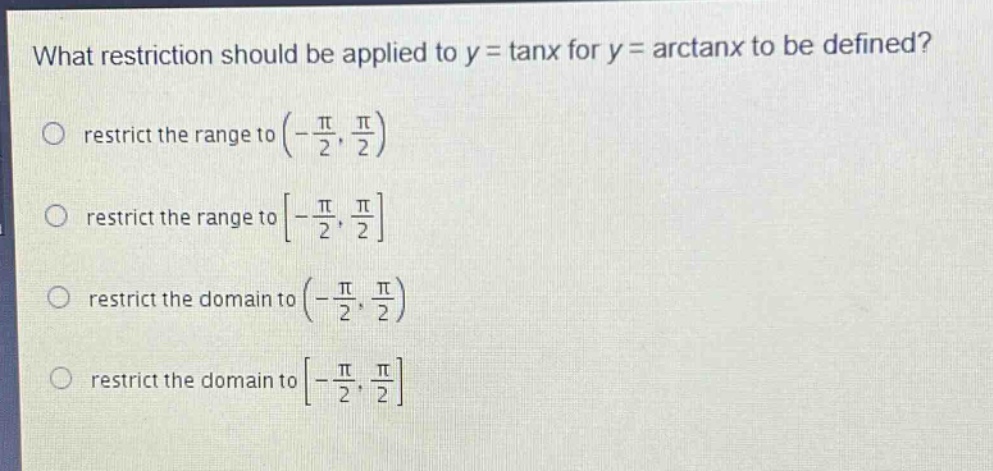
what restriction should be applied to y = tanx for y = arctanx to be defined?\nrestrict the range to (-\\frac{\\pi}{2}, \\frac{\\pi}{2})\nrestrict the range to -\\frac{\\pi}{2}, \\frac{\\pi}{2}\nrestrict the domain to (-\\frac{\\pi}{2}, \\frac{\\pi}{2})\nrestrict the domain to -\\frac{\\pi}{2}, \\frac{\\pi}{2}
Answer
Explanation:
Step1: Recall inverse - function concept
For a function (y = f(x)) to have an inverse (y = f^{-1}(x)), the original function (y = f(x)) must be one - to - one.
Step2: Analyze the tangent function
The function (y=\tan x) is periodic with period (\pi) and is not one - to - one over its entire domain. To make it one - to - one, we restrict its domain. The tangent function (y = \tan x) is defined as (y=\frac{\sin x}{\cos x}), and (\cos x = 0) at (x=\pm\frac{\pi}{2}+k\pi,k\in\mathbb{Z}). The function (y = \tan x) is one - to - one when we restrict its domain to ((-\frac{\pi}{2},\frac{\pi}{2})). Then the inverse function (y=\arctan x) (also written as (y = \tan^{-1}x)) is defined.
Answer:
C. restrict the domain to ((-\frac{\pi}{2},\frac{\pi}{2}))