review chapter 8. learning target #1: model situations with sine or cosine functions. 1. a frog is taking a…
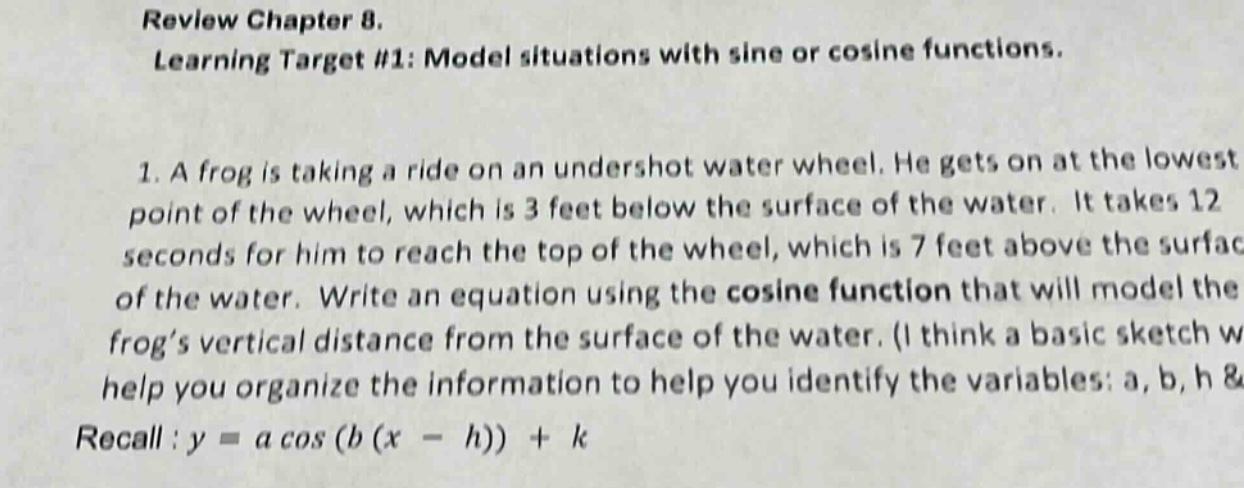
review chapter 8. learning target #1: model situations with sine or cosine functions. 1. a frog is taking a ride on an undershot water wheel. he gets on at the lowest point of the wheel, which is 3 feet below the surface of the water. it takes 12 seconds for him to reach the top of the wheel, which is 7 feet above the surface of the water. write an equation using the cosine function that will model the frog’s vertical distance from the surface of the water. (i think a basic sketch w help you organize the information to help you identify the variables: a, b, h & recall : y = a cos (b (x - h)) + k
Answer
Explanation:
Step1: Find the amplitude $a$
The total vertical distance from the lowest - point to the highest - point is $3 + 7=10$ feet. The amplitude $a$ is half of this distance, so $a=\frac{10}{2}=5$.
Step2: Find the vertical shift $k$
The mid - line of the motion is the average of the highest and lowest points. The mid - line is $\frac{- 3+7}{2}=2$ feet above the water surface, so $k = 2$.
Step3: Find the period $T$
It takes 12 seconds to go from the lowest point to the highest point. The period $T$ (time for a full cycle) is $2\times12 = 24$ seconds. Since the formula for the period of $y=a\cos(b(x - h))+k$ is $T=\frac{2\pi}{b}$, we can solve for $b$. Substituting $T = 24$ into $T=\frac{2\pi}{b}$, we get $b=\frac{2\pi}{24}=\frac{\pi}{12}$.
Step4: Find the horizontal shift $h$
The frog starts at the lowest point. For the cosine function $y = a\cos(b(x - h))+k$, when $x = 0$, we want the function to be at its minimum. The standard cosine function $y=\cos(x)$ has a minimum at $x=\pi$. So, if we set $b(0 - h)=\pi$ and $b=\frac{\pi}{12}$, then $\frac{\pi}{12}(-h)=\pi$, and $h=- 12$.
Answer:
$y = 5\cos\left(\frac{\pi}{12}(x + 12)\right)+2$