review the graph of the function f(x). the function shown has an endpoint discontinuity. which statement…
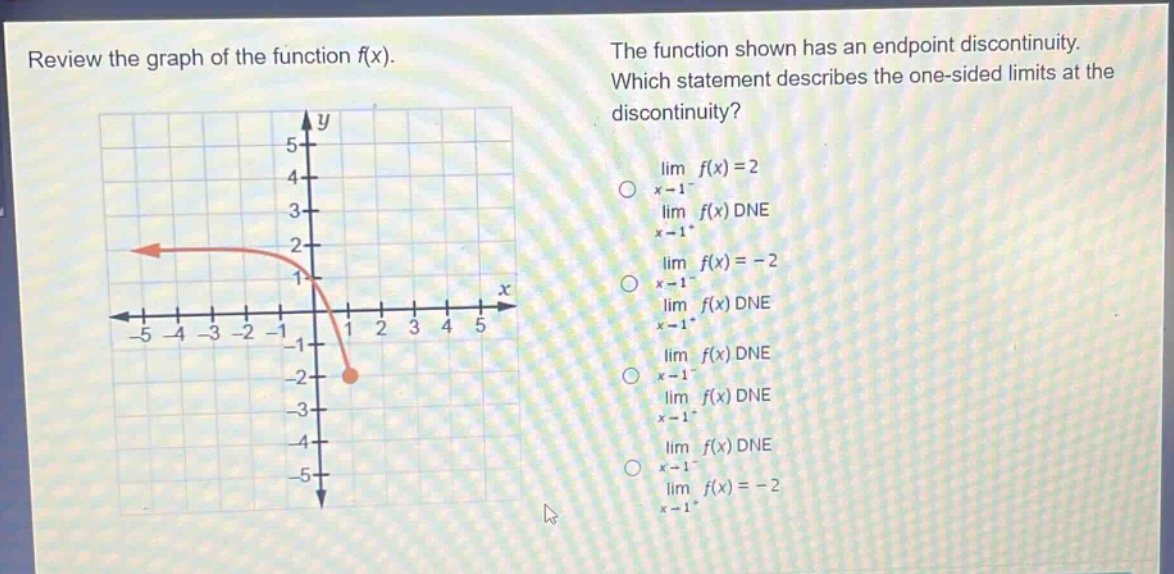
review the graph of the function f(x). the function shown has an endpoint discontinuity. which statement describes the one - sided limits at the discontinuity? lim f(x)=2 x→1⁻ lim f(x) dne x→1⁺ lim f(x)= - 2 x→1⁻ lim f(x) dne x→1⁺ lim f(x) dne x→1⁻ lim f(x) dne x→1⁺ lim f(x) dne x→1⁻ lim f(x)= - 2 x→1⁺
Answer
Explanation:
Step1: Determine the limit from the left.
As $x$ approaches $1$ from the left side (i.e., $x \to 1^-$), we observe the y-values of the function. The graph shows that as $x$ gets closer to $1$ from values less than $1$, $f(x)$ approaches $2$. $$ \lim_{x \to 1^-} f(x) = 2 $$
Step2: Determine the limit from the right.
As $x$ approaches $1$ from the right side (i.e., $x \to 1^+$), we observe the y-values of the function. The graph shows that the function is not defined for $x > 1$. Therefore, the limit as $x$ approaches $1$ from the right does not exist. $$ \lim_{x \to 1^+} f(x) \text{ DNE (Does Not Exist)} $$
Step3: Compare with the given options.
The first option states: $\lim_{x \to 1^-} f(x) = 2$ $\lim_{x \to 1^+} f(x)$ DNE This matches our findings.
Answer:
A. $\lim_{x \to 1^-} f(x) = 2$ $\lim_{x \to 1^+} f(x)$ DNE