review the graph of function g(x). what are lim_{x→4^{-}} g(x) and lim_{x→4^{+}} g(x), if they exist? o…
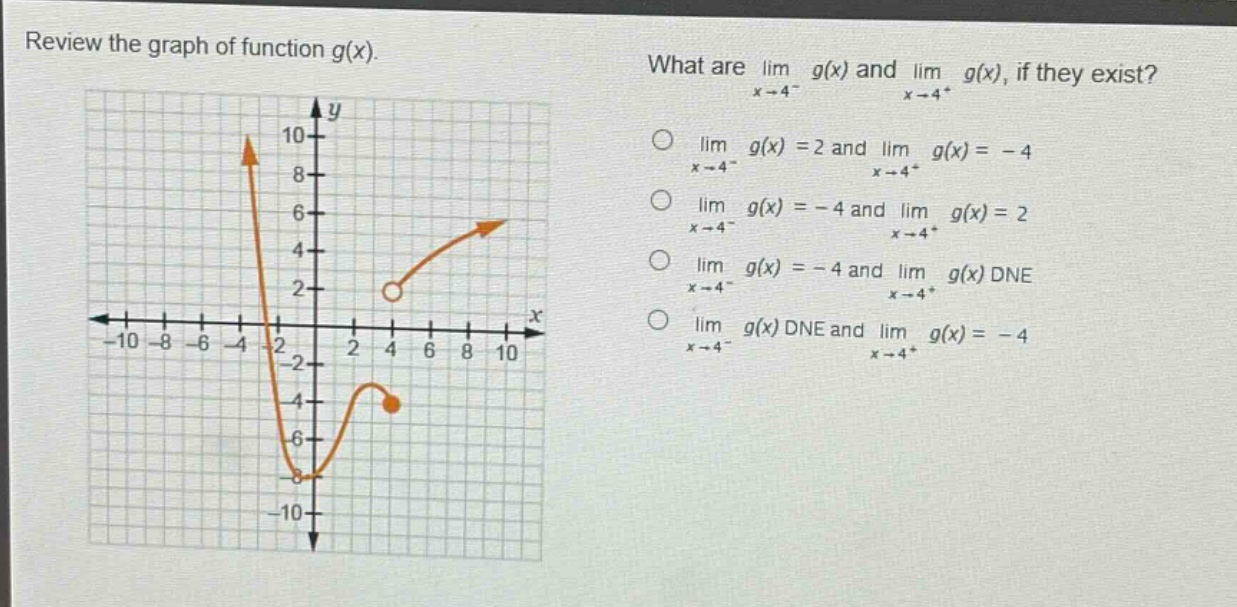
review the graph of function g(x). what are lim_{x→4^{-}} g(x) and lim_{x→4^{+}} g(x), if they exist? o lim_{x→4^{-}} g(x)=2 and lim_{x→4^{+}} g(x)= - 4 o lim_{x→4^{-}} g(x)= - 4 and lim_{x→4^{+}} g(x)=2 o lim_{x→4^{-}} g(x)= - 4 and lim_{x→4^{+}} g(x) dne o lim_{x→4^{-}} g(x) dne and lim_{x→4^{+}} g(x)= - 4
Answer
Explanation:
Step1: Analyze left - hand limit
As (x) approaches (4) from the left ((x\to4^{-})), we look at the part of the graph where (x) values are less than (4) but getting closer to (4). Following the curve of the function for (x < 4) near (x = 4), the (y) - value approaches (-4). So, (\lim_{x\to4^{-}}g(x)=-4).
Step2: Analyze right - hand limit
As (x) approaches (4) from the right ((x\to4^{+})), we look at the part of the graph where (x) values are greater than (4) but getting closer to (4). The function is not defined for (x>4) near (x = 4) (there is an open - circle and no curve to the right of (x = 4) near (x = 4)). So, (\lim_{x\to4^{+}}g(x)) does not exist (DNE).
Answer:
(\lim_{x\to4^{-}}g(x)=-4) and (\lim_{x\to4^{+}}g(x)\text{ DNE}), which corresponds to the option: (\lim_{x\to4^{-}}g(x)=-4) and (\lim_{x\to4^{+}}g(x)\text{ DNE})