review the graph of function g(x). what are lim x→4⁻ g(x) and lim x→4⁺ g(x), if they exist? o lim x→4⁻…
review the graph of function g(x). what are lim x→4⁻ g(x) and lim x→4⁺ g(x), if they exist? o lim x→4⁻ g(x)=2 and lim x→4⁺ g(x)= - 4 o lim x→4⁻ g(x)= - 4 and lim x→4⁺ g(x)=2 o lim x→4⁻ g(x)= - 4 and lim x→4⁺ g(x) dne o lim x→4⁻ g(x) dne and lim x→4⁺ g(x)= - 4
Answer
Explanation:
Step1: Analizar límite por la izquierda
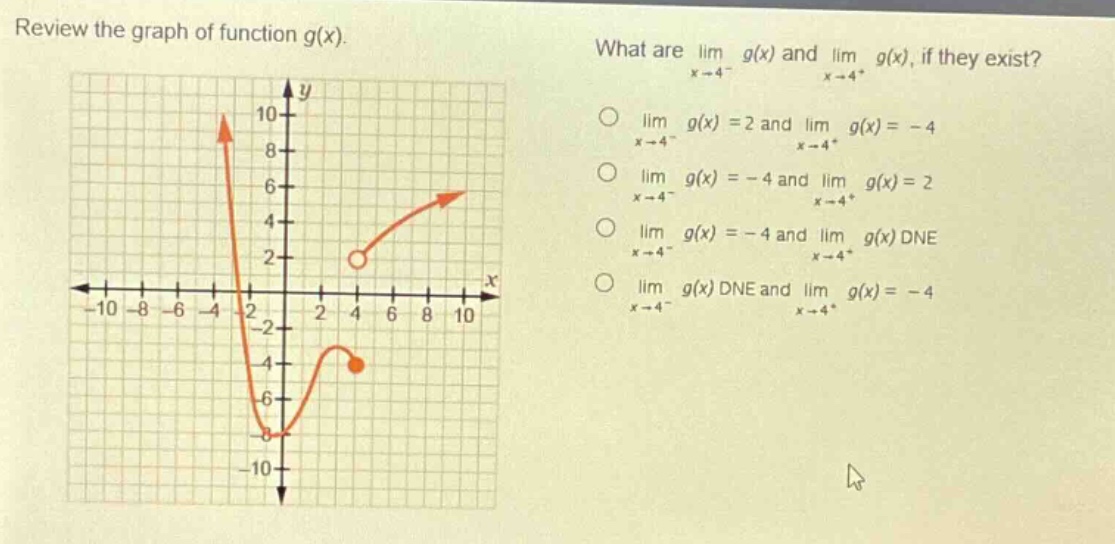
Al acercarse a (x = 4) desde la izquierda (valores de (x) menores que 4), observamos en el gráfico que (y) se aproxima a - 4. Entonces (\lim_{x\rightarrow4^{-}}g(x)=-4).
Step2: Analizar límite por la derecha
Al acercarse a (x = 4) desde la derecha (valores de (x) mayores que 4), observamos en el gráfico que (y) se aproxima a 2. Entonces (\lim_{x\rightarrow4^{+}}g(x)=2).
Answer:
(\lim_{x\rightarrow4^{-}}g(x)= - 4) and (\lim_{x\rightarrow4^{+}}g(x)=2), es decir, la segunda opción: (\lim_{x\rightarrow4^{-}}g(x)= - 4) y (\lim_{x\rightarrow4^{+}}g(x)=2)