review the graph of function f(x). which statement describes lim f(x) as x→1? the limit lim f(x) as x→1 = ∞…
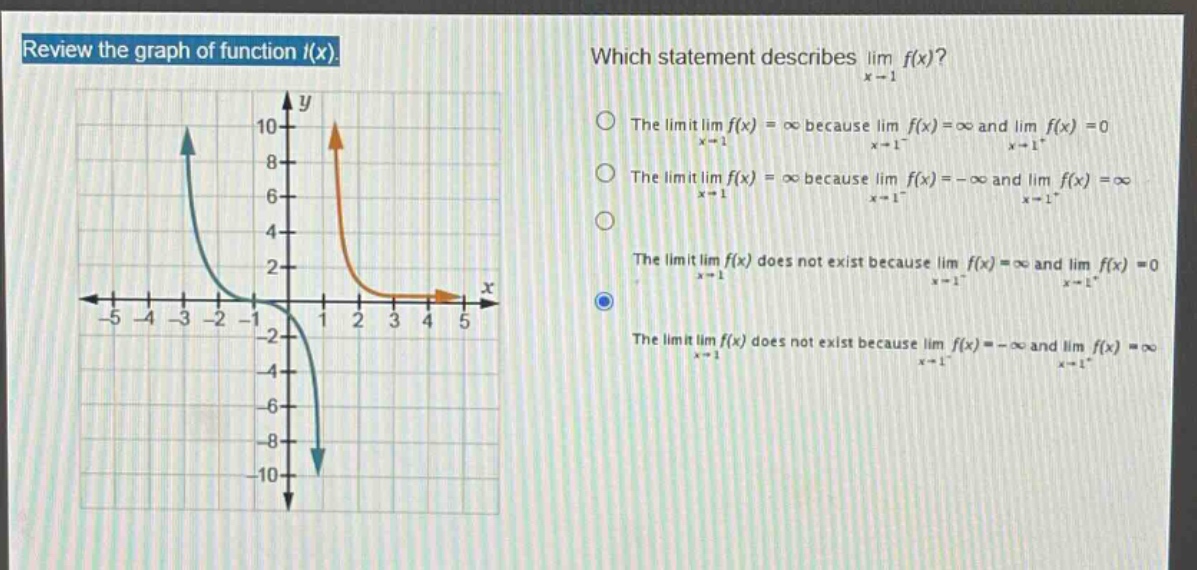
review the graph of function f(x). which statement describes lim f(x) as x→1? the limit lim f(x) as x→1 = ∞ because lim f(x) as x→1⁻ = ∞ and lim f(x) as x→1⁺ = 0. the limit lim f(x) as x→1 = ∞ because lim f(x) as x→1⁻ = -∞ and lim f(x) as x→1⁺ = ∞. the limit lim f(x) as x→1 does not exist because lim f(x) as x→1⁻ = ∞ and lim f(x) as x→1⁺ = 0. the limit lim f(x) as x→1 does not exist because lim f(x) as x→1⁻ = -∞ and lim f(x) as x→1⁺ = ∞.
Answer
Explanation:
Step1: Recall limit - existence condition
The limit $\lim_{x\rightarrow a}f(x)$ exists if and only if $\lim_{x\rightarrow a^{-}}f(x)=\lim_{x\rightarrow a^{+}}f(x)$.
Step2: Analyze left - hand and right - hand limits as $x\rightarrow1$
From the graph, as $x$ approaches $1$ from the left ($x\rightarrow1^{-}$), $f(x)\rightarrow-\infty$. As $x$ approaches $1$ from the right ($x\rightarrow1^{+}$), $f(x)\rightarrow\infty$.
Step3: Determine the existence of the limit
Since $\lim_{x\rightarrow1^{-}}f(x)\neq\lim_{x\rightarrow1^{+}}f(x)$, the limit $\lim_{x\rightarrow1}f(x)$ does not exist.
Answer:
The limit $\lim_{x\rightarrow1}f(x)$ does not exist because $\lim_{x\rightarrow1^{-}}f(x)=-\infty$ and $\lim_{x\rightarrow1^{+}}f(x)=\infty$