review the incomplete derivation of the cosine sum identity. step 1 cos(x + y) step 2 sin(π/2(x + y)) step 3…
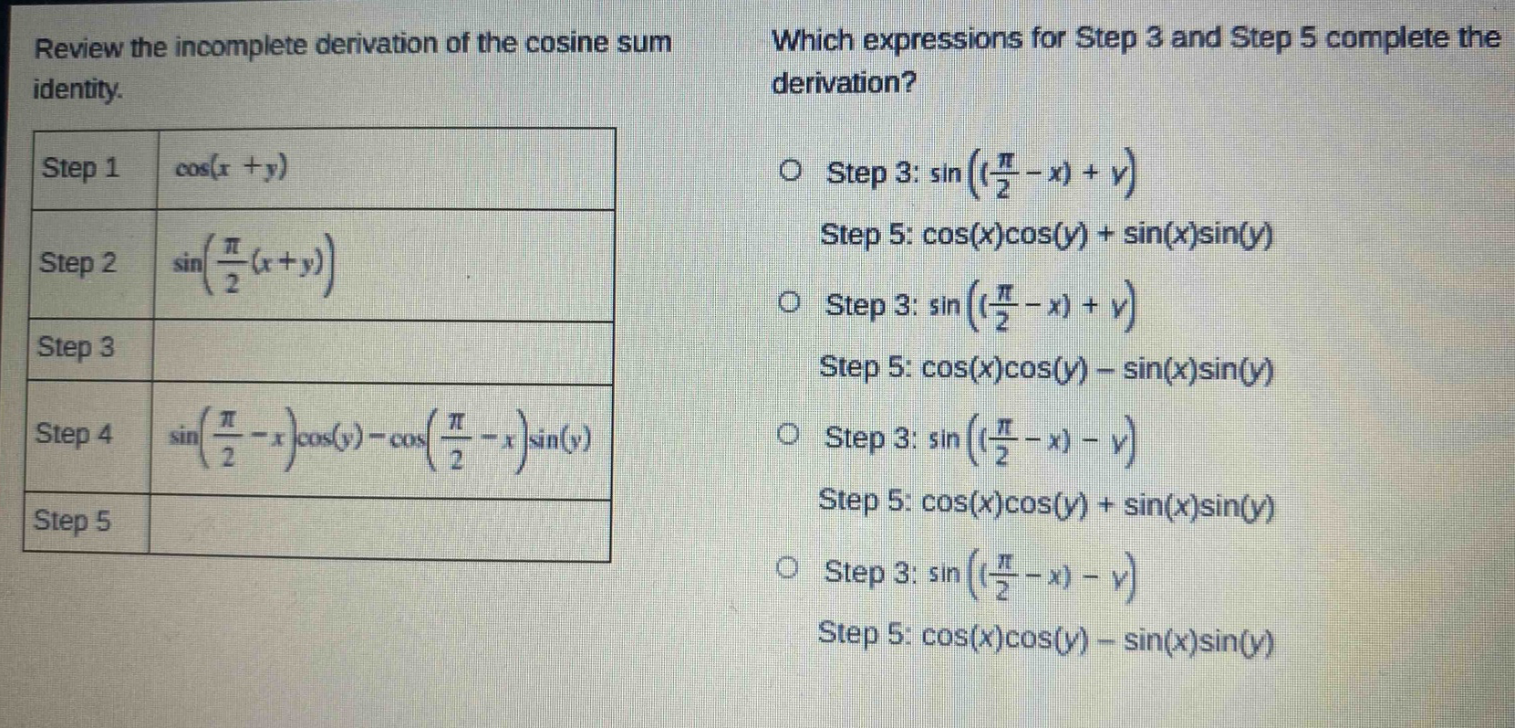
review the incomplete derivation of the cosine sum identity. step 1 cos(x + y) step 2 sin(π/2(x + y)) step 3 step 4 sin(π/2 - x)cos(y) - cos(π/2 - x)sin(y) step 5 which expressions for step 3 and step 5 complete the derivation? o step 3: sin((π/2 - x) + y) step 5: cos(x)cos(y) + sin(x)sin(y) o step 3: sin((π/2 - x) + y) step 5: cos(x)cos(y) - sin(x)sin(y) o step 3: sin((π/2 - x) - y) step 5: cos(x)cos(y) + sin(x)sin(y) o step 3: sin((π/2 - x) - y) step 5: cos(x)cos(y) - sin(x)sin(y)
Answer
Explanation:
Step1: Recall the co - function identity
We know that $\cos(A)=\sin(\frac{\pi}{2}-A)$. So, $\cos(x + y)=\sin(\frac{\pi}{2}-(x + y))=\sin((\frac{\pi}{2}-x)-y)$.
Step2: Use the sine - difference formula
The sine - difference formula is $\sin(A - B)=\sin(A)\cos(B)-\cos(A)\sin(B)$. For $A = \frac{\pi}{2}-x$ and $B = y$, we have $\sin((\frac{\pi}{2}-x)-y)=\sin(\frac{\pi}{2}-x)\cos(y)-\cos(\frac{\pi}{2}-x)\sin(y)$. We also know that $\sin(\frac{\pi}{2}-x)=\cos(x)$ and $\cos(\frac{\pi}{2}-x)=\sin(x)$.
Step3: Substitute the co - function identities
Substituting $\sin(\frac{\pi}{2}-x)=\cos(x)$ and $\cos(\frac{\pi}{2}-x)=\sin(x)$ into $\sin(\frac{\pi}{2}-x)\cos(y)-\cos(\frac{\pi}{2}-x)\sin(y)$, we get $\cos(x)\cos(y)-\sin(x)\sin(y)$.
Answer:
Step 3: $\sin((\frac{\pi}{2}-x)-y)$ Step 5: $\cos(x)\cos(y)-\sin(x)\sin(y)$