review the table of values for function h(x). which statement correctly explains whether the limit exists…
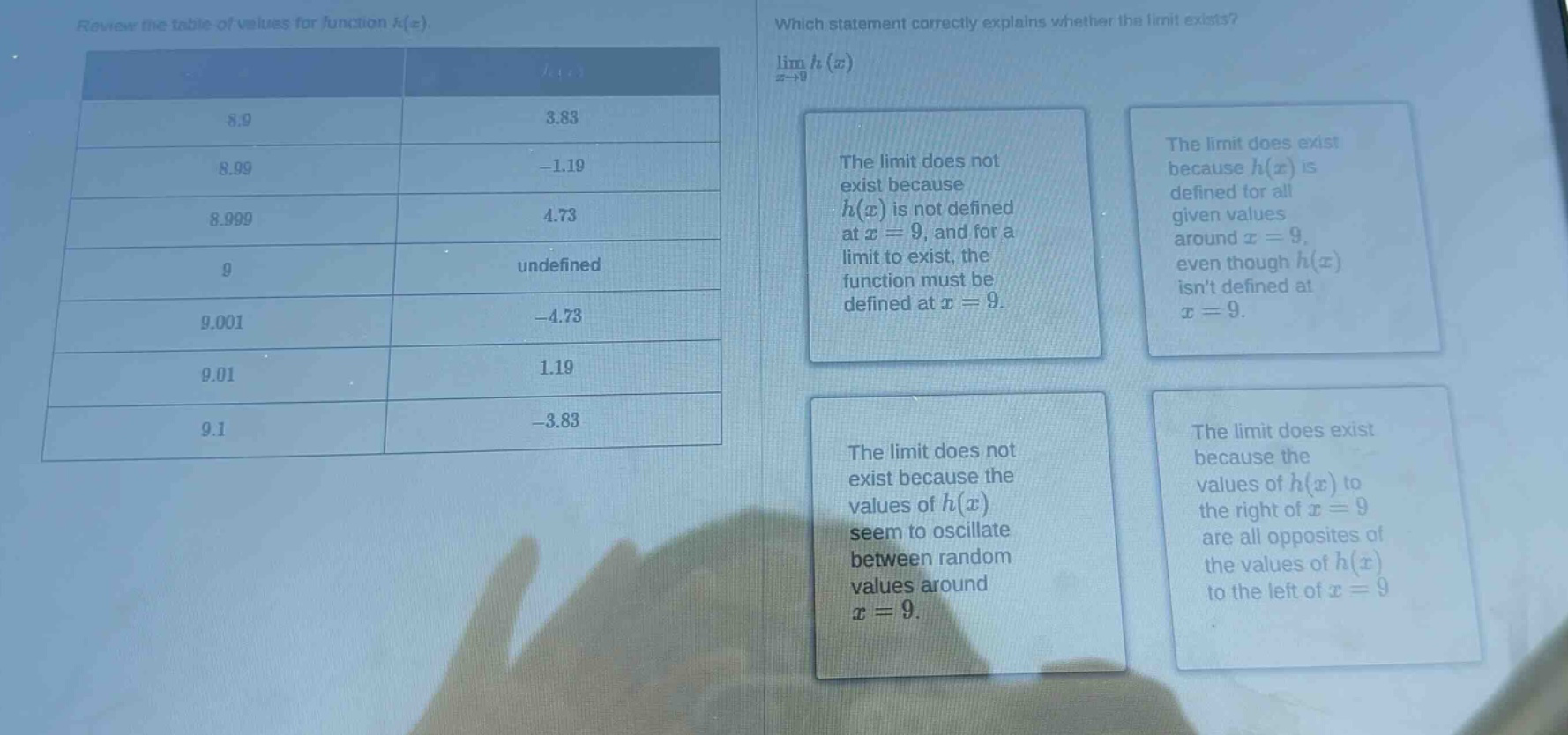
review the table of values for function h(x). which statement correctly explains whether the limit exists? lim h(x) as x→9. the limit does not exist because h(x) is not defined at x = 9, and for a limit to exist, the function must be defined at x = 9. the limit does exist because h(x) is defined for all given values around x = 9, even though h(x) isnt defined at x = 9. the limit does not exist because the values of h(x) seem to oscillate between random values around x = 9. the limit does exist because the values of h(x) to the right of x = 9 are all opposites of the values of h(x) to the left of x = 9. 8.9 3.83 8.99 -1.19 8.999 4.73 9 undefined 9.001 -4.73 9.01 1.19 9.1 -3.83
Answer
Explanation:
Step1: Recall limit definition
The limit $\lim_{x\rightarrow a}h(x)$ exists if the left - hand limit $\lim_{x\rightarrow a^{-}}h(x)$ and the right - hand limit $\lim_{x\rightarrow a^{+}}h(x)$ are equal, and it is not necessary for the function to be defined at $x = a$.
Step2: Analyze left - hand and right - hand limits
As $x$ approaches $9$ from the left ($x = 8.9,8.99,8.999$), the values of $h(x)$ are $3.83,-1.19,4.73$. As $x$ approaches $9$ from the right ($x=9.001,9.01,9.1$), the values of $h(x)$ are $- 4.73,1.19,-3.83$. The values of $h(x)$ to the right of $x = 9$ are all opposites of the values of $h(x)$ to the left of $x = 9$.
Step3: Determine limit existence
Since $\lim_{x\rightarrow9^{-}}h(x)\neq\lim_{x\rightarrow9^{+}}h(x)$ (the values do not approach a single value), the limit $\lim_{x\rightarrow9}h(x)$ does not exist because the values of $h(x)$ seem to oscillate between random values around $x = 9$.