riemann and trapezoidal sums from equations\nscore: 0/5 penalty: none\nquestion\nlet f be the function…
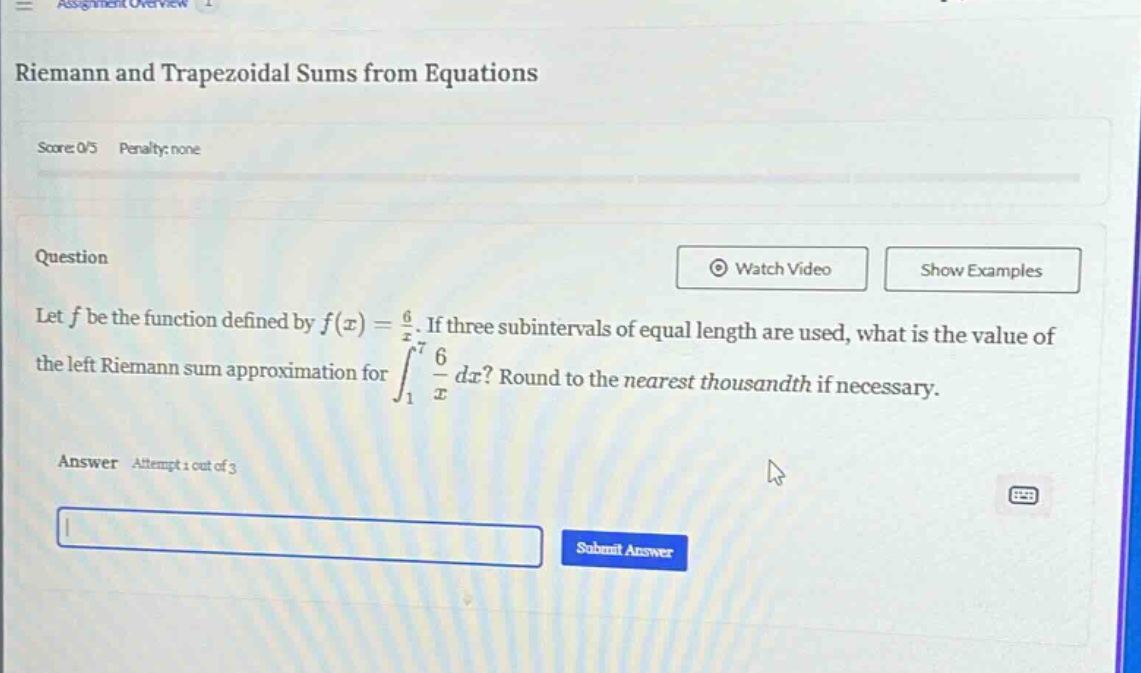
riemann and trapezoidal sums from equations\nscore: 0/5 penalty: none\nquestion\nlet f be the function defined by f(x) = 6/x. if three subintervals of equal length are used, what is the value of the left riemann sum approximation for ∫₁⁷ 6/x dx? round to the nearest thousandth if necessary.\nanswer attempt 1 out of 3\nsubmit answer
Answer
Answer:
14.8
Explanation:
Step1: Calculate sub - interval width
The interval is from $a = 1$ to $b = 7$. With $n=3$ sub - intervals, $\Delta x=\frac{b - a}{n}=\frac{7 - 1}{3}=2$.
Step2: Determine left - hand endpoints
The left - hand endpoints of the sub - intervals are $x_0 = 1,x_1=1 + 2=3,x_2=1+2\times2 = 5$.
Step3: Evaluate the function at endpoints
$f(x_0)=f(1)=\frac{6}{1}=6$, $f(x_1)=f(3)=\frac{6}{3}=2$, $f(x_2)=f(5)=\frac{6}{5}=1.2$.
Step4: Calculate left Riemann sum
$L_3=\sum_{i = 0}^{2}f(x_i)\Delta x=\Delta x(f(x_0)+f(x_1)+f(x_2))=2(6 + 2+1.2)=2\times9.2 = 14.8$.