to the right, you will see the graph of a function. ignoring whether it is increasing or decreasing, which…
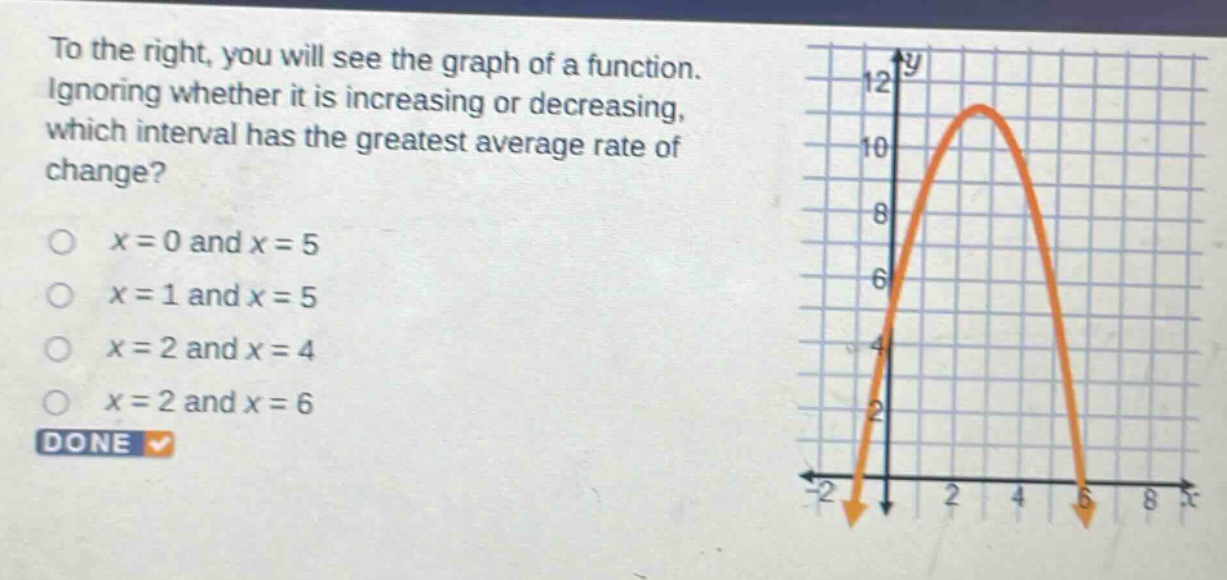
to the right, you will see the graph of a function. ignoring whether it is increasing or decreasing, which interval has the greatest average rate of change?\no x = 0 and x = 5\no x = 1 and x = 5\no x = 2 and x = 4\no x = 2 and x = 6\ndone
Answer
Explanation:
Step1: Recall average rate of change formula
The average rate of change of a function $y = f(x)$ over the interval $[a,b]$ is $\frac{f(b)-f(a)}{b - a}$, which is the slope of the secant - line through the points $(a,f(a))$ and $(b,f(b))$. We can estimate the function values from the graph.
Step2: Estimate function values for $x = 0$ and $x = 5$
Let's assume $f(0)\approx5$ and $f(5)\approx11$. Then the average rate of change over $[0,5]$ is $\frac{f(5)-f(0)}{5 - 0}=\frac{11 - 5}{5}=\frac{6}{5}=1.2$.
Step3: Estimate function values for $x = 1$ and $x = 5$
Suppose $f(1)\approx7$ and $f(5)\approx11$. Then the average rate of change over $[1,5]$ is $\frac{f(5)-f(1)}{5 - 1}=\frac{11 - 7}{4}=1$.
Step4: Estimate function values for $x = 2$ and $x = 4$
Assume $f(2)\approx9$ and $f(4)\approx11$. Then the average rate of change over $[2,4]$ is $\frac{f(4)-f(2)}{4 - 2}=\frac{11 - 9}{2}=1$.
Step5: Estimate function values for $x = 2$ and $x = 6$
Suppose $f(2)\approx9$ and $f(6)\approx5$. Then the average rate of change over $[2,6]$ is $\frac{f(6)-f(2)}{6 - 2}=\frac{5 - 9}{4}=-1$. The magnitude is $1$.
Answer:
A. $x = 0$ and $x = 5$