8. rotate about y = 2: v = volume = type your answer... cubic units
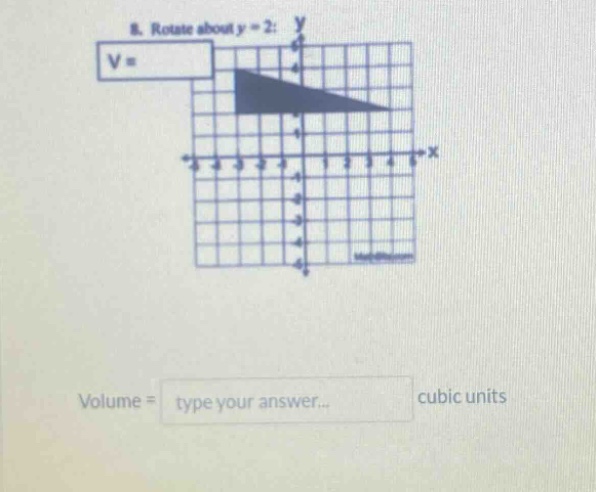
8. rotate about y = 2: v = volume = type your answer... cubic units
Answer
Explanation:
Step1: Identify the method
We can use the disk - washer method. First, find the equations of the lines bounding the region. Let's assume the vertices of the triangle are found from the grid. Suppose the triangle has vertices ((x_1,y_1)), ((x_2,y_2)), ((x_3,y_3)). We need to express the functions in terms of (x).
Step2: Set up the integral for volume
The volume (V) of a solid of revolution about the line (y = k) using the disk - washer method is given by (V=\pi\int_{a}^{b}([R(x)]^{2}-[r(x)]^{2})dx), where (R(x)) is the outer radius and (r(x)) is the inner radius. For rotation about (y = 2), we find the vertical distances from the line (y = 2) to the upper and lower boundaries of the region at each (x) value in the interval ([a,b]) of the region's projection on the (x) - axis. However, without the exact coordinates of the vertices of the triangle from the grid, assume the triangle is bounded by (y_1(x)) and (y_2(x)) on the interval ([x_1,x_2]). The outer radius (R(x)=2 - y_2(x)) and the inner radius (r(x)=2 - y_1(x)) (assuming (y_1(x)\leq y_2(x))). Then (V=\pi\int_{x_1}^{x_2}((2 - y_2(x))^{2}-(2 - y_1(x))^{2})dx=\pi\int_{x_1}^{x_2}(4-4y_2(x)+y_2^{2}(x)-(4 - 4y_1(x)+y_1^{2}(x)))dx=\pi\int_{x_1}^{x_2}(4y_1(x)-4y_2(x)+y_2^{2}(x)-y_1^{2}(x))dx). If we assume the triangle has vertices ((1,1)), ((4,1)), ((1,4)) (by estimating from the grid): The line passing through ((1,1)) and ((1,4)) is (x = 1), the line passing through ((1,1)) and ((4,1)) is (y = 1), and the line passing through ((1,4)) and ((4,1)) is (y=-x + 5). The outer radius (R(x)=2 - 1=1) and the inner radius (r(x)=2-(-x + 5)=x - 3) for (x\in[1,4]). [ \begin{align*} V&=\pi\int_{1}^{4}(1-(x - 3)^{2})dx\ &=\pi\int_{1}^{4}(1-(x^{2}-6x + 9))dx\ &=\pi\int_{1}^{4}(-x^{2}+6x - 8)dx\ &=\pi\left[-\frac{1}{3}x^{3}+3x^{2}-8x\right]_{1}^{4}\ &=\pi\left[\left(-\frac{64}{3}+48-32\right)-\left(-\frac{1}{3}+3 - 8\right)\right]\ &=\pi\left[\left(-\frac{64}{3}+16\right)-\left(-\frac{1}{3}-5\right)\right]\ &=\pi\left[-\frac{64}{3}+16+\frac{1}{3}+5\right]\ &=\pi\left[-\frac{63}{3}+21\right]\ &=6\pi \end{align*} ]
Answer:
(6\pi)