8. rotate about y = 2: y v = volume = type your answer... cubic units
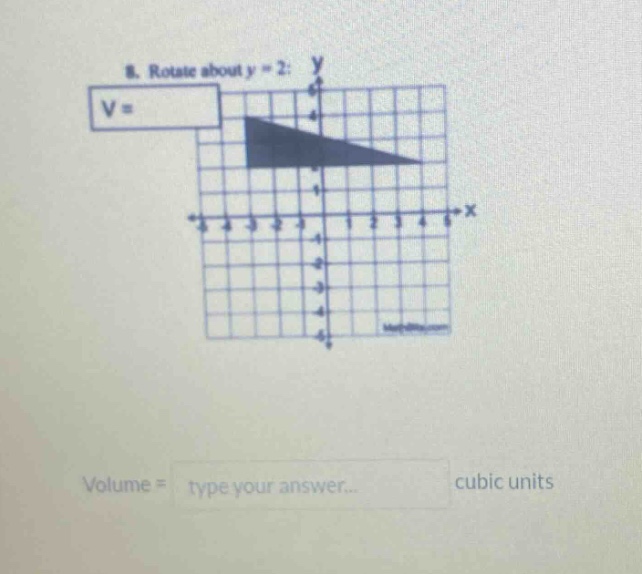
8. rotate about y = 2: y v = volume = type your answer... cubic units
Answer
Explanation:
Step1: Identify the method
We can use the disk - washer method. First, find the equations of the lines of the sides of the triangle. Let's assume the vertices of the triangle are found from the grid (say ((- 1,2)), ((3,2)) and ((3,4))). The distance from the axis of rotation (y = 2) to a point ((x,y)) on the region is (r=y - 2).
Step2: Set up the integral
We will use the formula for the volume of a solid of revolution (V=\pi\int_{a}^{b}[R(x)^2 - r(x)^2]dx). In this case, since we are rotating about (y = 2), for the region bounded by the triangle, we can consider vertical slices. The left - hand (x) value is (x=-1) and the right - hand (x) value is (x = 3). The upper function (y_{2}) and lower function (y_{1}) with respect to (x): The line passing through ((-1,2)) and ((3,4)) has the equation (y=\frac{4 - 2}{3+1}(x + 1)+2=\frac{1}{2}x+\frac{5}{2}), and the lower function (y = 2). The radius of the cross - section at a given (x) is (r=\frac{1}{2}x+\frac{5}{2}-2=\frac{1}{2}x+\frac{1}{2}). [V=\pi\int_{-1}^{3}(\frac{1}{2}x+\frac{1}{2})^2dx]
Step3: Expand the integrand
[(\frac{1}{2}x+\frac{1}{2})^2=\frac{1}{4}x^{2}+\frac{1}{2}x+\frac{1}{4}] So (V=\pi\int_{-1}^{3}(\frac{1}{4}x^{2}+\frac{1}{2}x+\frac{1}{4})dx)
Step4: Integrate term - by - term
(\int(\frac{1}{4}x^{2}+\frac{1}{2}x+\frac{1}{4})dx=\frac{1}{4}\times\frac{1}{3}x^{3}+\frac{1}{2}\times\frac{1}{2}x^{2}+\frac{1}{4}x+C=\frac{1}{12}x^{3}+\frac{1}{4}x^{2}+\frac{1}{4}x+C)
Step5: Evaluate the definite integral
[V=\pi\left[\frac{1}{12}x^{3}+\frac{1}{4}x^{2}+\frac{1}{4}x\right]_{-1}^{3}] [=\pi\left[\left(\frac{1}{12}(3)^{3}+\frac{1}{4}(3)^{2}+\frac{1}{4}(3)\right)-\left(\frac{1}{12}(-1)^{3}+\frac{1}{4}(-1)^{2}+\frac{1}{4}(-1)\right)\right]] [=\pi\left[\left(\frac{27}{12}+\frac{9}{4}+\frac{3}{4}\right)-\left(-\frac{1}{12}+\frac{1}{4}-\frac{1}{4}\right)\right]] [=\pi\left[\left(\frac{27 + 27+9}{12}\right)-\left(-\frac{1}{12}\right)\right]] [=\pi\left[\frac{63}{12}+\frac{1}{12}\right]=\frac{16\pi}{3}]
Answer:
(\frac{16\pi}{3})